
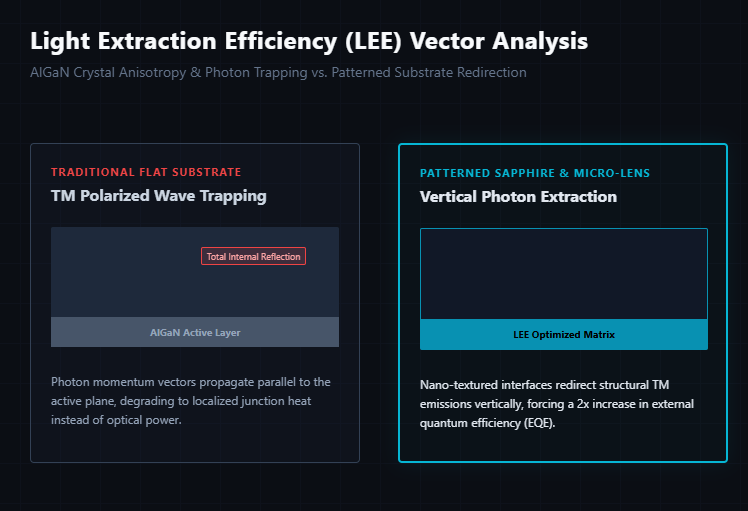
For optical engineers developing next-generation disinfection devices, the primary design barrier is not form factor—it is optical efficiency. While visible-light LEDs regularly achieve External Quantum Efficiency (EQE) scores exceeding 60%, a commercial deep uv-c led historically operates at an EQE of just 2% to 5%. Understanding the solid-state physics behind this efficiency bottleneck is essential for engineering teams tasked with maximizing system radiation output.
The AlGaN Material Dilemma
Deep ultraviolet light requires a high aluminum mole fraction within the Aluminum Gallium Nitride (AlGaN) semiconductor active layer. This chemical composition shifts the light emission into the germicidal 230-280nm window. However, high aluminum concentrations present two severe material challenges:
-
Poor Electrical Conductivity: High aluminum levels severely restrict hole injection efficiency, meaning a significant portion of the input current is converted into heat rather than photons.
-
Light Extraction Efficiency (LEE) Drops: Unlike blue LEDs, which emit light isotropically, AlGaN structures emit a large percentage of light parallel to the chip plane (TM polarization). These photons become trapped inside the semiconductor crystal due to total internal reflection and are reabsorbed as waste heat.
  Standard TM Wave:   [ Photon Trapped Inside Semiconductor Substrate ] ➔ Heat
  Nano-Structured:    [ Sapphire Pattern Mirror ] ➔ [ Photons Extracted Vertically ]
Engineering Higher Photon Yields
To bypass this physical bottleneck, tier-one manufacturers are redesigning the internal chip architecture. By implementing patterned sapphire substrates (PSS), specialized reflective p-contacts, and micro-lens arrays at the wafer level, developers can force photons to redirect vertically. This advanced light extraction engineering effectively doubles the usable optical output without increasing the current draw.
When developing advanced sterilization equipment, relying on low-efficiency, generic components will compromise your system's performance. Partnering with an optical specialist that offers a highly efficient deep uv-c led 230-280nm customization platform ensures your design utilizes chips optimized for maximum light extraction, delivering the peak radiant flux density your industrial application demands.