
The most critical parameter on any B2B hardware data sheet is the component lifespan, specifically the L70 rating (the time it takes for the optical output to drop to 70% of its initial value). In high-power applications, a deep uv-c led encounters severe degradation forces that visible-light emitters are immune to. For R&D teams building continuous-duty sanitation equipment, managing this internal stress is the deciding factor between product success and catastrophic warranty failure.
Dislocation Density and Thermal Stress
The underlying cause of deep UV degradation is a combination of crystal defects and intense heat localization. Because AlGaN layers are grown on sapphire substrates, a slight atomic mismatch occurs, creating threading dislocations in the crystal structure.
When a high forward current passes through these microscopic defects, it generates intense heat. If this heat is not immediately conducted away from the active region, the junction temperature ($T_j$) spikes, accelerating defect growth and permanently disabling sections of the light-emitting area.
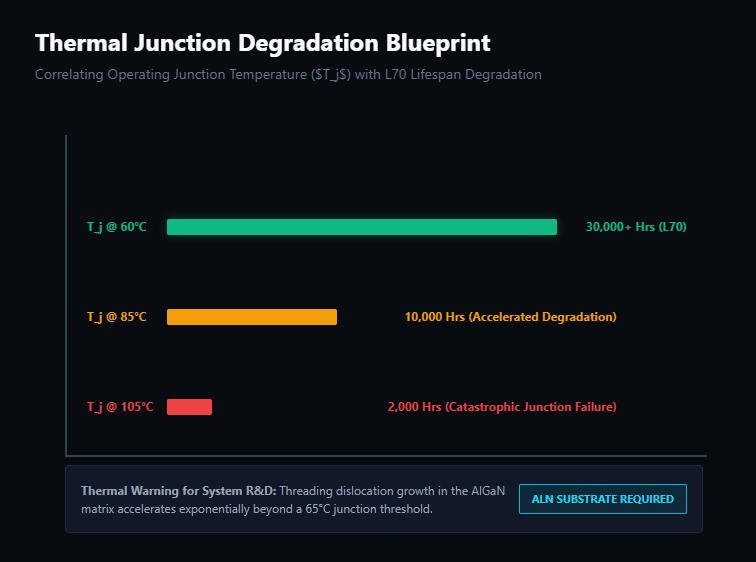
  Junction Temp (Tj) vs. L70 Lifespan:
  • Tj @ 60°C  ➔  ■■■■■■■■■■■■■■■■■■■■  30,000+ Hours (Optimal)
  • Tj @ 85°C  ➔  ■■■■■■■■■■  10,000 Hours (Accelerated Aging)
  • Tj @ 105°C ➔  ■■■  2,000 Hours (Catastrophic Degradation)
Optimizing System Drive Waveforms
To protect the semiconductor matrix, engineering teams must look beyond passive heat sinks and evaluate their electrical drive strategies:
-
Pulse-Width Modulation (PWM) Driving: Instead of running continuous high DC currents, operating the array via high-frequency PWM allows the chip junctions a microsecond cooling window between pulses, reducing overall thermal accumulation.
-
Balanced Parallel-Series Substrates: Ensuring that current is distributed equally across every single die prevents a phenomenon known as current crowding, where a single chip draws too much power and burns out prematurely.
Sustained industrial performance requires specialized hardware engineering. Selecting robustly packaged deep uv-c led custom modules built on high-conductivity ceramic backplanes ensures uniform current distribution and optimal heat transfer, allowing your commercial product lines to easily achieve stable, long-term L70 lifetimes exceeding 30,000 hours.