
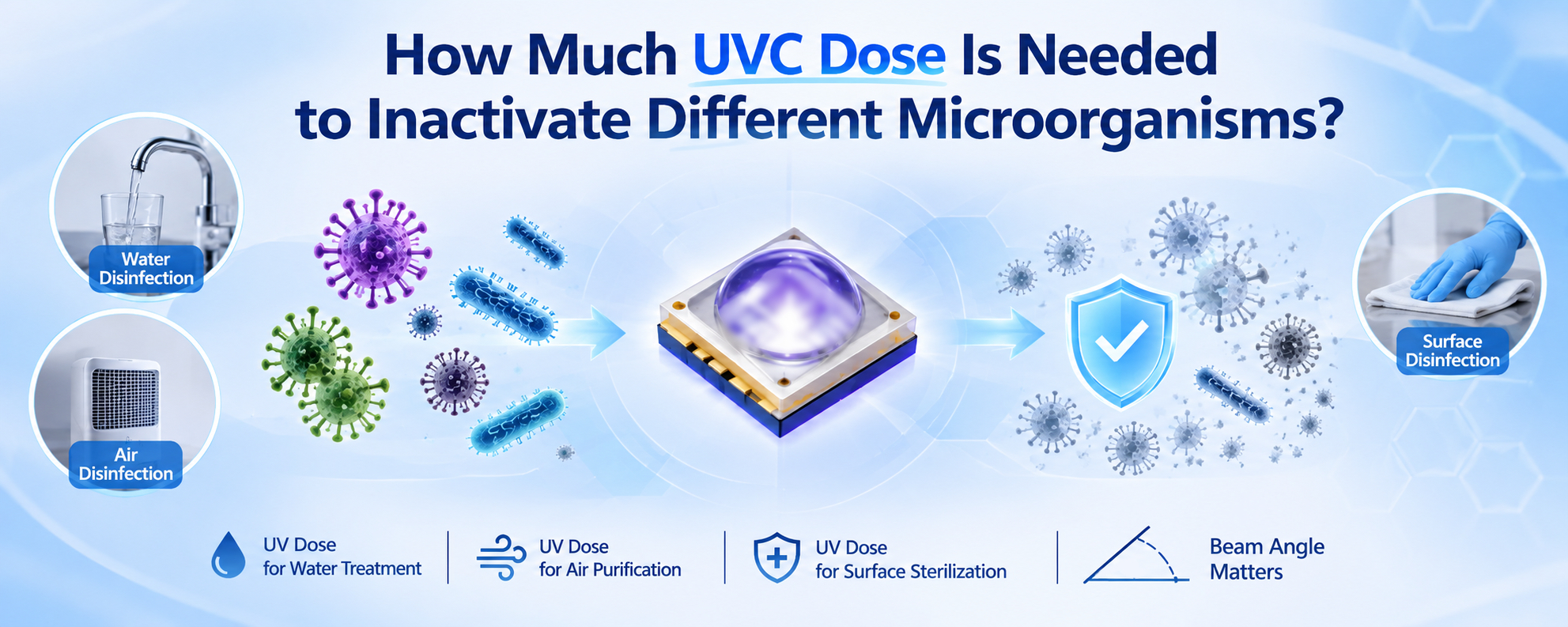
Ultraviolet (UV) LED technology has become an increasingly attractive solution for water disinfection, air purification, and surface decontamination. However, one important question often determines whether a UV disinfection system can achieve its intended performance: How much UV dose is actually required to inactivate different microorganisms?
Not all microorganisms respond to UVC radiation in the same way. Some common bacteria can be inactivated at relatively low doses, while certain viruses, bacterial spores, and other UV-resistant microorganisms require considerably higher exposure.
For UV LED manufacturers and equipment designers, understanding these differences is essential. An insufficient UV dose may result in inadequate microbial inactivation, while excessive output can increase energy consumption and system costs.
This guide explores the UV dose requirements of common bacteria, viruses, and microorganisms in water, air, and surface disinfection. It also explains how to plan UV LED water disinfection sterilizer and why LED beam angle plays an important role in achieving effective UV exposure.
1. Understanding UV Dose: Why Does It Matter in Disinfection?
Before discussing individual microorganisms, it is important to understand what UV dose means.
UV dose, also known as UV fluence, represents the amount of UV energy received by a target surface or microorganism over a specific exposure period.
It is commonly expressed in mJ/cm² (millijoules per square centimeter)
UV dose is determined by two primary factors:
- UV irradiance: The UV energy received per unit area, typically measured in mW/cm².
- Exposure time: The duration for which microorganisms are exposed to UV radiation, measured in seconds.
A simplified relationship is: UV Dose = UV Irradiance × Exposure Time
For example, if a microorganism receives a UV irradiance of 1 mW/cm² for 10 seconds, its theoretical UV dose is 10 mJ/cm².
However, this calculation assumes constant irradiance and uniform exposure. Actual disinfection systems may have uneven UV distribution, changing water flow, and variations in optical transmission.
Another important concept is log reduction, which describes the percentage of microorganisms inactivated:
|
Log Reduction |
Microorganisms Inactivated |
|
1-log |
90% |
|
2-log |
99% |
|
3-log |
99.9% |
|
4-log |
99.99% |
|
5-log |
99.999% |
|
6-log |
99.9999% |
A higher log reduction generally requires a higher UV dose. However, the relationship between dose and microbial inactivation depends on the organism and the irradiation conditions. Understanding both UV dose and log reduction is therefore essential when designing a UV disinfection system.
2. How Much UV Dose Do Different Microorganisms Require?
Different microorganisms have different levels of resistance to UVC radiation. Their sensitivity is influenced by their biological structure, genetic material, protective mechanisms, and surrounding environment.
The following examples illustrate why UV dose selection must be based on the target microorganism rather than a universal dosage value.
2.1 Common Bacteria
Bacteria such as Escherichia coli (E. coli), Salmonella, and Staphylococcus aureus are frequently considered when evaluating UV disinfection performance.
- coli is commonly used as an indicator organism in water disinfection studies because it is relevant to microbial water quality and has well-documented UV inactivation characteristics.
According to the U.S. EPA's UV Treatment Toolkit, reported doses for E. coli are approximately:
- 0 mJ/cm² for 1-log reduction
- 8 mJ/cm² for 2-log reduction
- 7 mJ/cm² for 3-log reduction
- 4 mJ/cm² for 4-log reduction
These values demonstrate that relatively low UV fluences can achieve substantial E. coli inactivation under suitable test conditions.
However, not all bacteria are equally sensitive. For example, Bacillus subtilis is commonly used as a more UV-resistant biological indicator.
The EPA toolkit reports approximately 62 mJ/cm² for a 4-log reduction of Bacillus subtilis, considerably higher than the reported E. coli value.
This difference highlights an important consideration for equipment manufacturers: a UV module designed around E. coli alone may not provide sufficient performance against more UV-resistant microorganisms.
2.2 Common Viruses
Viruses can present different UV disinfection challenges depending on their structure and UV susceptibility.
Common examples include:
- MS2 bacteriophage: Frequently used as a surrogate for studying viral inactivation in water treatment.
- Adenovirus: A non-enveloped virus that can be relatively resistant to UV radiation.
- Influenza virus: An enveloped respiratory virus commonly studied in air disinfection research.
- Human coronaviruses: Studied in both airborne and surface disinfection applications.
MS2 bacteriophage is particularly useful when evaluating UV water treatment systems.
According to the EPA's reported challenge microorganism data, MS2 requires approximately:
- 16 mJ/cm² for 1-log reduction
- 34 mJ/cm² for 2-log reduction
- 52 mJ/cm² for 3-log reduction
- 71 mJ/cm² for 4-log reduction
These figures are substantially higher than the reported E. coli requirements.
Adenovirus also deserves particular attention. Its relatively high UV resistance makes it an important consideration when designing systems intended for broader viral inactivation.
For equipment manufacturers, this means that a water disinfection sterilizer intended to address viral contamination may require a different dose target from one designed primarily for bacterial reduction.
2.3 Bacterial Spores and More Resistant Microorganisms
Some microorganisms have protective structures that make them more resistant to environmental stress.
Bacterial spores, including those associated with Bacillus species, are particularly important examples.
The EPA toolkit reports the following UV dose requirements for Bacillus subtilis:
|
Target Inactivation |
UV Dose |
|
1-log |
28 mJ/cm² |
|
2-log |
39 mJ/cm² |
|
3-log |
50 mJ/cm² |
|
4-log |
62 mJ/cm² |
These values illustrate why designing a UV system for a higher level of microbial resistance may require substantially more UV energy.
It is also important to distinguish between vegetative bacteria and bacterial spores. Results obtained using ordinary bacterial cells should not automatically be applied to spore inactivation.
For applications requiring broad-spectrum microbial control, equipment designers should identify the actual target organisms and determine whether additional treatment or a higher validated UV dose is necessary.
3. UV Dose Requirements Across Water, Air, and Surface Disinfection
Although the same UVC technology can be used across different applications, the required dose and system design are not necessarily interchangeable.
The surrounding environment directly influences how much UV energy reaches microorganisms.
3.1 UV Dose for Water Disinfection
Water disinfection is one of the most demanding applications for UV LED Sterilizer design because microorganisms are continuously transported through a reactor.
The effectiveness of a water disinfection system depends on several parameters:
- Target microorganism and required log reduction
- Water flow rate
- UV transmittance (UVT)
- UV LED optical output
- Reactor geometry and optical distribution
- Exposure time and hydraulic conditions
For example, the EPA's drinking water guidance provides the following UV dose requirements for specific microbial inactivation credits at 254 nm:
|
Target Microorganism |
2-log Reduction |
3-log Reduction |
4-log Reduction |
|
Cryptosporidium |
5.8 |
12 |
22 |
|
Giardia lamblia |
5.2 |
11 |
22 |
|
Virus (regulatory category) |
100 |
143 |
186 |
Unit: mJ/cm². These are EPA regulatory dose requirements for specified drinking water treatment applications, referenced to 254 nm low-pressure mercury lamp output. They should not be interpreted as universal experimental dose-response values for every UV LED wavelength or water treatment system.
The differences are significant.
For example, achieving 3-log inactivation credit for Cryptosporidium requires 12 mJ/cm² under this guidance, whereas the corresponding regulatory requirement for viruses is 143 mJ/cm².
This is why water treatment manufacturers should not select a UV LED module based solely on its rated optical power.
A practical approach to water module dose planning
For preliminary UV LED water sterilizer design, engineers can use the following framework:
|
Application Objective |
Preliminary Dose Consideration |
|
General bacterial reduction |
Evaluate a starting range around 10–20 mJ/cm² |
|
Higher bacterial reduction or broader microbial control |
Evaluate approximately 20–40 mJ/cm² |
|
Viral surrogate inactivation |
Evaluate approximately 40–80+ mJ/cm² |
|
More demanding viral treatment targets |
Determine dose from the target organism, log reduction, and applicable standards; potentially substantially higher |
These ranges are preliminary engineering discussion points, not guaranteed performance specifications or regulatory compliance values.
For example, EPA data indicate that MS2 requires approximately 52 mJ/cm² for 3-log reduction under the cited challenge-organism test conditions. This makes it a useful reference when considering more demanding viral treatment applications.
The final design dose must be established through organism-specific testing and reactor validation.
3.2 UV Dose for Air Disinfection
In air disinfection, UVC radiation is commonly used in upper-room UVGI systems, HVAC air treatment equipment, and enclosed air purification devices.
Common target microorganisms include:
- Mycobacterium tuberculosis
- Influenza viruses
- Human coronaviruses
- coli and other airborne bacterial indicators
- MS2 bacteriophage, used as a viral surrogate in research
Unlike water disinfection, airborne microorganisms may pass through a UV irradiation zone for only a short period.
Consequently, air disinfection performance depends on both UV intensity and the time microorganisms spend within the irradiated area.
Airflow speed, air mixing, relative humidity, UV exposure geometry, and microorganism susceptibility all influence the final result.
For example, an air purification system with high UV output may still provide inadequate inactivation if the air passes through the treatment zone too quickly.
Therefore, air disinfection equipment should be designed around the relationship between UV irradiance, airflow, and exposure time rather than relying on the LED's rated power alone.
3.3 UV Dose for Surface Disinfection
Surface disinfection is another common application for UVC LEDs, including medical equipment, food processing surfaces, packaging, and industrial workstations.
Typical microorganisms studied in surface disinfection include:
- Staphylococcus aureus
- Escherichia coli
- Salmonella
- SARS-CoV-2
- Influenza viruses
- Bacillus spores
Compared with water treatment, surface disinfection presents a different challenge: microorganisms may be shielded by dust, organic residues, surface irregularities, or overlapping materials.
Even when the UV LED produces sufficient radiation, microorganisms located in shadows or underneath contaminants may receive significantly less energy.
For example, published UVC LED research has reported approximately 3-log reduction of certain SARS-CoV-2 variants using 280 nm irradiation at 18.75 mJ/cm² in a specific laboratory setup.
This result should not be generalized to every surface, microorganism, or disinfection device.
For surface disinfection equipment, uniform irradiation, exposure distance, surface geometry, and the presence of organic contamination must all be considered.
4. How to Plan the UV Dose of a Water Disinfection Module
Among the three applications discussed above, water disinfection requires particularly careful consideration of hydraulic and optical conditions.
A UV LED module may have sufficient optical output under laboratory conditions but still fail to deliver the intended dose when integrated into a real water system.
The following parameters should be evaluated during the design process.
4.1 Target Microorganism and Required Log Reduction
The first step is to identify what the system needs to inactivate.
For example:
- An under-sink water purifier may primarily focus on bacterial reduction.
- A commercial drinking water dispenser may require broader microbial control.
- An industrial water treatment system may need to address more UV-resistant organisms.
The target microorganism determines the required UV dose.
A design targeting 3-log E. coli reduction should not automatically be considered suitable for 3-log MS2 reduction.
4.2 Water Flow Rate and Exposure Time
Flow rate directly affects the exposure conditions inside a water disinfection sterilizer.
When water passes through the reactor more quickly, microorganisms generally have less time to receive UV radiation.
For example, consider a simplified comparison:
- System A: 1 mW/cm² average irradiance for 20 seconds.
- System B: 1 mW/cm² average irradiance for 5 seconds.
Their theoretical doses would be 20 mJ/cm² and 5 mJ/cm², respectively.
Although the UV LED output is identical, the delivered exposure is different.
This is why engineers must consider the intended water flow rate when selecting the number of LEDs, optical output, and reactor dimensions.
4.3 UV Transmittance and Water Quality
UV transmittance (UVT) describes how effectively UV light passes through water.
Water containing suspended particles, organic compounds, or other UV-absorbing substances may transmit less UV radiation.
When UVT decreases, microorganisms may receive less UV energy even if the LED output remains unchanged.
Water quality should therefore be evaluated before determining the final module configuration.
In particular, systems treating water with variable turbidity or UVT may require additional optical output, improved filtration, or a different reactor design.
4.4 Reactor Geometry and UV Distribution
A UV LED water module must deliver sufficient exposure throughout the water flow path.
If the UV radiation is concentrated near the LED while other areas receive significantly less energy, microorganisms passing through different regions may experience different doses.
This creates a non-uniform UV dose distribution.
A well-designed reactor should consider:
- LED placement and orientation
- Optical distance between LEDs and water
- Reflective surfaces and reactor materials
- Water channel dimensions
- Flow distribution and mixing
The objective is not simply to increase the maximum UV intensity, but to improve the minimum effective exposure received by microorganisms passing through the system.
For continuous-flow systems, reactor validation is particularly important because actual UV dose depends on both the optical field and the hydraulic conditions.
5. How to Choose the Right UV LED SMD for a Disinfection Project
When selecting a UV LED package for water, air, or surface disinfection, engineers should evaluate more than its rated optical power.
Several parameters need to be considered together.
- Wavelength
Different microorganisms and applications may respond differently to different UVC wavelengths.
Common UVC LED wavelengths include 260 nm, 265 nm, 270 nm, 275 nm, and 280 nm.
The appropriate wavelength should be selected according to the target microorganism, application medium, and system design.
- Optical Power
Optical power determines how much UV energy the LED emits.
However, the rated output of an individual LED does not directly represent the UV dose received by microorganisms inside a complete disinfection system.
- Beam Angle
The emission angle affects the distribution of UV radiation and should match the optical geometry of the device. To learn how beam angle affects UV LEDs, please read this blog post: UV LED Beam Angle Guide: Applications of 15°, 60° & 120° Angles
- Thermal Management
UV LED performance can be affected by operating temperature.
Appropriate thermal design helps maintain stable optical output and reliable long-term operation.
- Package Structure and Customization
The LED package, substrate, optical lens, and electrical configuration all influence integration into the final equipment.
For OEM manufacturers, choosing a package that matches the actual optical and thermal requirements of the project can help improve overall system design.
Conclusion: Effective UV Disinfection Starts with the Right Dose and Optical Design
UV LED disinfection is not simply a matter of selecting a high-power LED.
Different microorganisms require different UV exposure levels, and water, air, and surface applications present different challenges.
For water treatment equipment manufacturers, selecting an appropriate dose requires careful consideration of the target microorganism, required log reduction, water flow rate, UV transmittance, and reactor geometry.
Beam angle is another important parameter because it influences how UV radiation is distributed throughout the treatment area.
A successful UV disinfection system must therefore combine appropriate wavelength selection, sufficient optical output, optimized emission angles, and well-designed reactor structures.
At LED INTRO, we provide UV LED SMD solutions for OEM and ODM applications, with customizable wavelengths, optical power options, and emission angles to support different UV disinfection system requirements.
Looking for the right UVC LED package for your next disinfection project? Contact our team to discuss your wavelength, optical power, and beam angle requirements.