
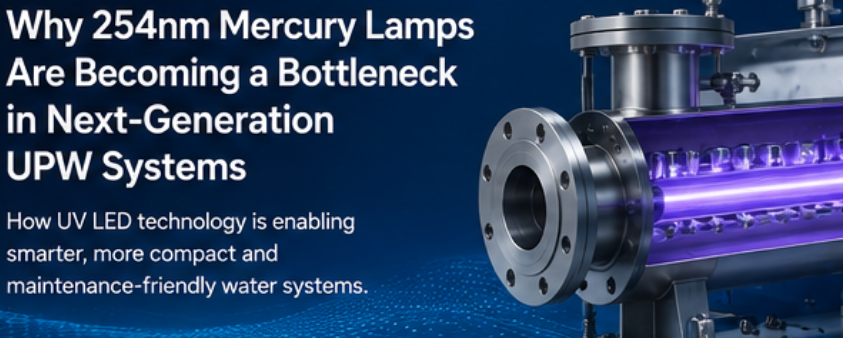
For decades, 254nm mercury lamps have been the standard solution for UV sterilization in ultrapure water (UPW) systems.
But in many next-generation platforms, especially those designed for semiconductor fabs, pharmaceutical process systems, and compact intelligent water modules, the discussion is changing.
The question is no longer:
“Can UV LED replace mercury lamps?”
The real engineering question is:
“How long can conventional mercury architectures continue supporting the next generation of UPW equipment requirements?”
This shift is happening because the bottleneck is no longer purely microbial performance.
Modern UPW systems now require:
- faster operational response
- modular integration
- lower maintenance complexity
- compact reactor architecture
- dynamic sterilization control
- environmental compliance
- distributed disinfection capability
These requirements increasingly expose the structural limitations of conventional low-pressure mercury systems.
The Real Limitation of Mercury UV Systems
Traditional mercury lamps work well in large centralized sterilization systems. However, many modern water-treatment platforms are no longer designed around centralized architecture.
In semiconductor and pharmaceutical systems, equipment manufacturers are moving toward:
- compact distributed treatment nodes
- point-of-use sterilization
- localized microbial control
- intelligent process monitoring
- lower energy standby operation
This is where mercury systems begin struggling.
Typical limitations include:
Warm-Up Delay
Mercury lamps require startup stabilization time before reaching full optical output. In intermittent-flow systems or sensor-triggered sterilization cycles, this becomes inefficient.
Reactor Volume
Conventional UV lamps often require larger reactor chambers and longer optical paths, which complicates compact system integration.
Thermal Load
Mercury systems generate significant radiant and environmental heat, which becomes increasingly problematic in tightly controlled UPW environments.
Maintenance Downtime
Lamp replacement cycles, quartz fouling, ballast maintenance, and mercury handling increase long-term operational complexity.
Dynamic Control Limitations
Modern smart water systems increasingly require variable irradiation control based on:
- flow rate
- microbial risk level
- sensor feedback
- operating cycle
Mercury systems are not naturally optimized for this level of dynamic modulation.
Why UV LED Changes the Architecture
Unlike mercury lamps, UV LEDs fundamentally change how sterilization systems can be designed.
Particularly in 255nm, 265nm, and 275nm ranges, UV LEDs allow engineers to rethink reactor structure entirely.
Instant ON/OFF Capability
One of the biggest operational advantages is immediate optical response.
UV LEDs can activate only when sterilization is required, dramatically improving energy efficiency in intermittent operation environments.
Compact Modular Integration
UV LED POB and COB structures allow compact integration directly into:
- circulation loops
- dispensing systems
- compact skids
- sensor modules
- distributed flow channels
This enables much smaller reactor footprints.
Intelligent Sterilization Control
UV LED systems can be dynamically adjusted using:
- PWM dimming
- sensor-triggered activation
- flow-linked irradiation
- distributed wavelength control
This aligns extremely well with Industry 4.0 water-system architectures.
Mercury-Free Compliance
Many industrial sectors are gradually moving toward mercury-free equipment standards.
This trend is especially important in:
- semiconductor manufacturing
- pharmaceutical production
- medical systems
- environmental engineering
UV LED platforms naturally support this transition.
Why Wavelength Selection Matters
Different UV wavelengths now play different roles inside advanced UPW systems.
255nm UV LED
Often used for:
- organic monitoring
- UV absorbance applications
- compact sensing systems
- microbial control
265nm UV LED
Provides extremely strong DNA/RNA absorption performance and is commonly used in high-efficiency germicidal systems.
275nm UV LED
Offers strong sterilization performance with better maturity, thermal stability, and integration flexibility for larger-scale systems.
Modern UPW systems increasingly combine multiple wavelengths rather than relying on one single UV source.
The Future of UPW UV Systems
The industry trend is becoming increasingly clear.
Future ultrapure water systems are likely to become:
- smaller
- smarter
- distributed
- sensor-driven
- dynamically controlled
- modular
UV LED architecture aligns naturally with this direction.
In many next-generation projects, the conversation has already shifted away from “lamp replacement.”
The real focus is now:
“How should UV LED systems be architected for next-generation process water platforms?”
That is a much bigger transition than simply changing the light source.
For customized 230–280nm UV LED solutions used in water treatment, sensing, and compact sterilization systems, explore: https://www.u-vcare.com/products/uvc-leds-230-280nm-full-band-customization