
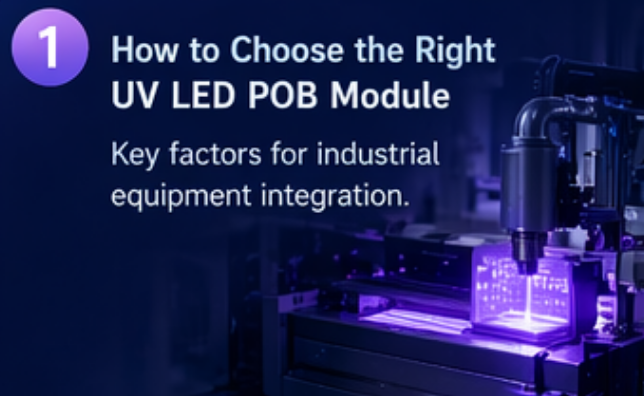
For OEM equipment manufacturers, selecting a UV LED module is rarely about choosing the highest power output. The real challenge is choosing a module architecture that fits the final machine design, thermal limits, control system, and optical target. This is where POB (Package on Board) UV LED modules are increasingly preferred over discrete LED assembly.
Unlike traditional PCB-mounted single emitters, POB modules integrate packaged UV LEDs directly into a high-density board layout, allowing more flexible spacing, faster assembly, and easier maintenance. For industrial systems, this can significantly shorten development cycles.
When evaluating a UV LED POB module, engineers usually focus on five key factors:
1. Wavelength Accuracy
Different applications require different peak wavelengths:
- 265–280nm for water and air disinfection
- 308nm for medical / dermatology systems
- 365nm for fluorescence and inspection
- 385nm / 395nm for curing inks, coatings, adhesives
Choosing the wrong wavelength often causes lower efficiency than simply choosing lower power.
2. Irradiance at Working Distance
Bench power values can be misleading. Ask suppliers for irradiance data at your actual distance (10mm / 20mm / 50mm etc.).
3. Thermal Path Design
A strong UV module with poor cooling rapidly loses output. POB modules should be evaluated with aluminum, copper, or liquid-cooled mounting options.
4. Electrical Configuration
Can the module match your driver system? Voltage/current customization saves redesign costs later.
5. Mechanical Integration
Mounting holes, dimensions, connector orientation, waterproofing, lens angle—all matter in real equipment.
For OEM projects, custom POB modules usually outperform generic catalog products because they reduce system compromises.
If your equipment requires UV LEDs as part of a larger machine, choosing a supplier who understands integration—not just LED sales—is critical.