
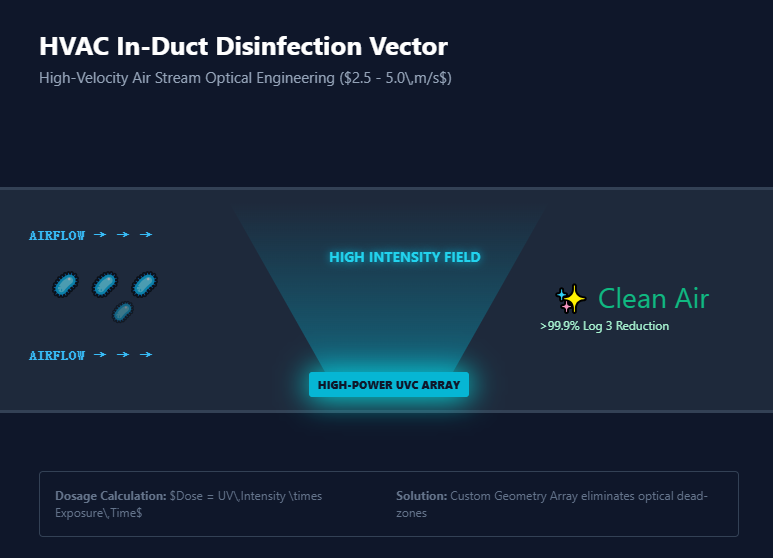
In high-risk environments like hospitals, containment laboratories, and pharmaceutical packaging facilities, air purification solutions must meet strict bio-safety protocols. In these settings, the localized air changes per hour (ACH) must be completely sterile. Integrating Ultraviolet Germicidal Irradiation (UVGI) directly into commercial Heating, Ventilation, and Air Conditioning (HVAC) systems is the most effective way to sanitize large volumes of moving air.
However, engineering UVGI for moving air streams requires precise calculations regarding air velocity and target microbial dosage.
       Airflow Track --> [ === High Velocity Airflow === ]
                                 ↑   ↑   ↑   ↑
       UVC Array Target -->  [ High-Power UVC LED Module ]
Overcoming the Air Velocity Challenge
Unlike surface disinfection, where a light source shines on a static object for minutes, HVAC air purification happens in a fraction of a second. Air traveling through a typical commercial duct moves at speeds ranging from 2.5 to 5 meters per second ($m/s$).

-
Traditional lamps often fail here because their low power-density requires massive exposure chambers.
-
High-power UVC LED arrays can concentrate intense radiant intensity into a highly localized zone.
Strategic Placement Within the HVAC Loop
To maximize efficiency, optical modules should be placed facing the cooling coils or immediately downstream from them. This serves a dual purpose: it continuously disinfects the high-velocity air stream and prevents the formation of bio-films on the damp cooling coils, which is a major source of Sick Building Syndrome (SBS).
Because every HVAC duct system features unique dimensions, standard off-the-shelf light bars often lead to dead zones with zero UV coverage. Commercial HVAC manufacturers require highly configurable solutions. Exploring an advanced industrial-grade UVC LED 230-280nm customization service gives engineering teams the freedom to specify exact optical viewing angles, forward currents, and physical module sizes needed to ensure uniform, high-dose coverage across any industrial duct cross-section.