
The global manufacturing sector is undergoing a major shift toward smart, sustainable design. In both consumer appliances and heavy industrial machinery, legacy mercury lamps are being phased out in favor of solid-state disinfection platforms. Integrating a deep uv-c led core allows product designers to build intelligent, connected sanitation features that were impossible to implement using old-school glass tubes.
Implementing Intelligent Closed-Loop Control
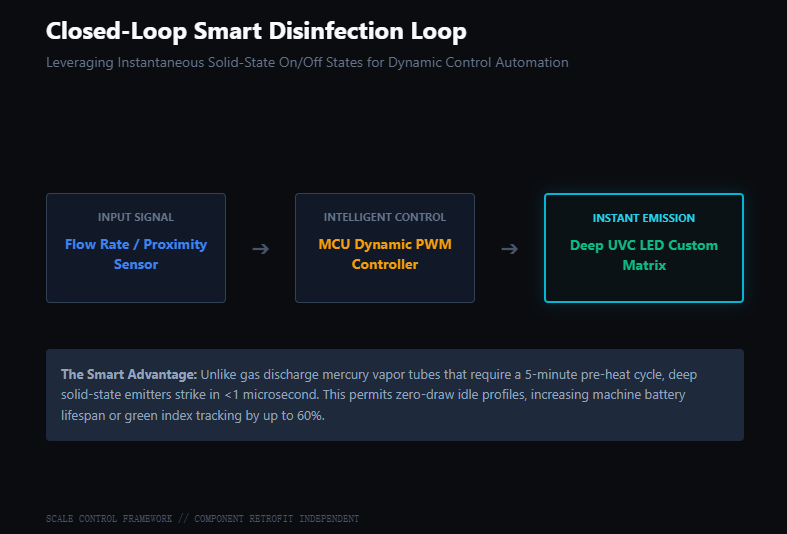
Unlike mercury tubes that require a warm-up phase and must remain continuously powered, solid-state semiconductors respond instantly to control signals. This enabling feature allows developers to implement highly efficient, on-demand sanitation systems:
[ Flow/Proximity Sensor ] ➔ [ Microcontroller (PWM Controller) ] ➔ Instantaneous [ Deep UVC Module Activation ]
-
Sensor-Driven Operation: By linking the LED array to flow meters, proximity sensors, or optical clarity monitors, the module can activate instantly when fluid motion or a surface touch is detected, drawing power only when necessary.
-
Precision Duty-Cycle Optimization: Microcontrollers can precisely adjust the ultraviolet output power using PWM, scaling up during high-demand periods and dimming during idle states to significantly extend the operational life of the device.
Miniaturization and Design Freedom
The compact footprint of modern surface-mount devices (SMDs) allows germicidal arrays to be integrated directly into tight operational zones—such as inside refrigerator water dispensers, medical diagnostic bays, or handheld dental sterilizers.
Transitioning to smart, mercury-free hardware requires specialized engineering support. Sourcing your components through an experienced deep uv-c led 230-280nm customization platform gives your engineering team access to flexible PCB dimensions, built-in constant-current drivers, and tailored optical ray patterns, ensuring your new product lines launch with a strong competitive advantage.