
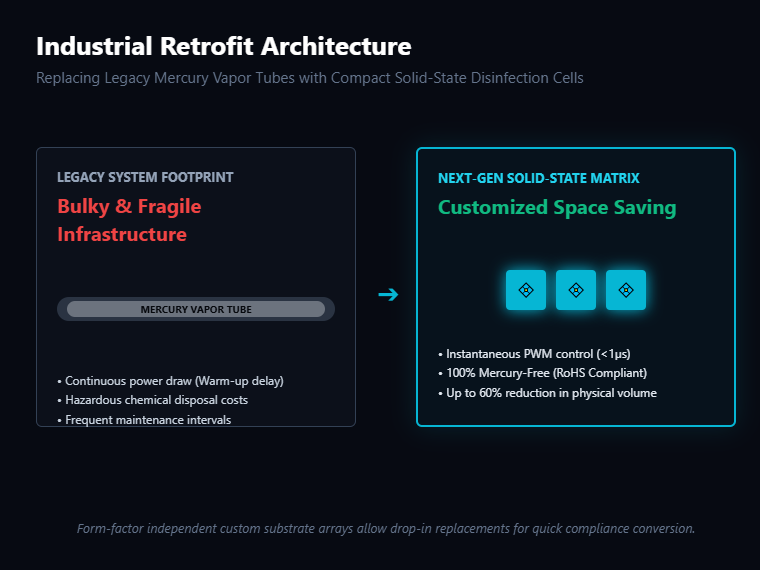
The industrial sterilization landscape is undergoing an enforced technological evolution. Under the international Minamata Convention on Mercury, global regulations are rapidly tightening around the manufacture, import, and export of products containing added mercury. For equipment manufacturers (OEMs) relying on low-pressure mercury vapor lamps for sanitation, the message is clear: the transition to solid-state uv led disinfection systems is no longer a future option—it is an immediate operational necessity.
Economic and Operational Architecture: Mercury vs. UVC LED
| Feature Operational | Low-Pressure Mercury Lamps | Solid-State UVC LEDs (230-280nm) |
| Environmental Risk | High (Contains toxic mercury vapor) | Zero (100% RoHS & REACH Compliant) |
| Power Cycling | Lifespan degraded by turning ON/OFF | Infinite cycling with zero degradation |
| Startup Phase | Requires 1 to 5 minutes to stabilize | Instantaneous response (<1 microsecond) |
| Physical Vulnerability | Fragile glass tubes prone to breaking | Solid-state semiconductor shock resistance |
| Footprint Volume | Bulky space requirements | Ultra-compact integration limits |
The Financial Realities of Late Adaptation
Remaining tied to mercury infrastructure introduces severe long-term supply chain risks. As manufacturing plants phase out traditional glass tubes, replacement component costs will skyrocket.
Furthermore, from an energy perspective, mercury lamps waste considerable electricity by constantly remaining turned on to avoid the warm-up delay. UVC LEDs operate via instantaneous pulse-width modulation (PWM), drawing power only when fluid or air is actively moving through the chamber. This reduces system energy usage by up to 60%.
For global B2B brands looking to future-proof their machinery for North American and European markets, designing retrofits is the current priority. Partnering with a component specialist that offers an advanced UVC LED 230-280nm customization service allows your R&D team to substitute legacy lamps with ultra-compact, high-radiant flux arrays that match your existing power and spatial specifications seamlessly.