
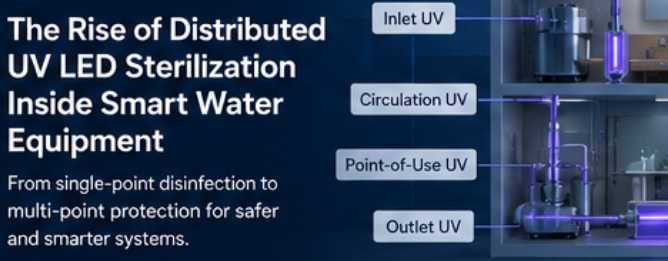
Traditional UV water systems were usually designed around a single sterilization reactor.
But smart water equipment is changing this model.
Today, many advanced systems are beginning to adopt distributed UV LED sterilization architecture.
Instead of relying on one centralized UV chamber, sterilization is now being integrated into multiple locations throughout the system.
Why Distributed UV Matters
In real equipment, contamination risk does not exist at only one point.
Microbial growth can occur in:
- inlet tubing
- circulation loops
- reservoirs
- dispensing nozzles
- stagnant water sections
- user-contact areas
A single UV reactor may reduce overall microbial load, but it cannot always prevent secondary contamination.
This is why distributed sterilization is becoming attractive.
Typical Distributed UV Architecture
Modern smart water systems may include:
Inlet UV Sterilization
Used to reduce incoming microbial load.
Circulation UV Modules
Used to suppress biofilm growth during standby operation.
Outlet UV Protection
Used near dispensing areas to minimize contamination risk.
Sensor-Triggered UV Zones
Activated dynamically based on system operation.
UV LEDs make this architecture practical because of:
- compact size
- instant ON/OFF capability
- low-voltage operation
- modular integration
- flexible optical design
Why UV LED Changes Equipment Design
Mercury lamps are difficult to distribute throughout compact systems.
UV LEDs, however, can be embedded directly into:
- faucets
- bottle-filling stations
- ice dispensers
- beverage systems
- compact purification modules
This allows sterilization to become part of the equipment architecture itself.
Why This Matters for Future Water Systems
Smart water systems are increasingly becoming:
- sensor-connected
- modular
- compact
- low-maintenance
- energy-optimized
Distributed UV LED integration aligns naturally with these trends.
Future systems may dynamically activate sterilization only where and when it is needed.
This improves:
- energy efficiency
- maintenance flexibility
- microbial safety
- system intelligence
Distributed UV architecture is likely to become one of the defining trends in next-generation water equipment engineering.
For customized UV LED POB and COB solutions used in distributed sterilization systems, explore: https://www.u-vcare.com/products/uvc-leds-230-280nm-full-band-customization