
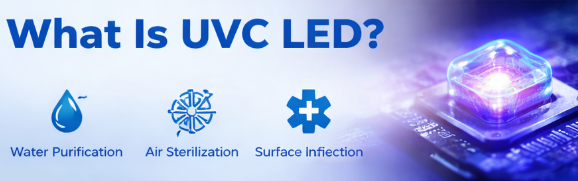
What Is UVC LED?
UVC LED refers to ultraviolet light-emitting diodes that operate in the wavelength range of 200–280nm. This range, known as deep ultraviolet (UVC), is highly effective in destroying microorganisms such as bacteria, viruses and fungi.
Unlike traditional mercury UV lamps, UVC LEDs are compact, energy-efficient and environmentally friendly, making them ideal for modern industrial applications.
How UVC LED Works
UVC LEDs emit photons that penetrate microbial cells and damage their DNA or RNA. This prevents the microorganisms from reproducing, effectively neutralizing them.
The most effective wavelengths are typically between 260nm and 270nm, where DNA absorption peaks.
Key Advantages of UVC LED Technology
- Mercury-free and environmentally friendly
- Instant on/off operation
- Compact and flexible design
- Long lifespan (10,000–20,000+ hours)
- Low energy consumption
Industrial Applications of UVC LED
1. Water Treatment
UVC LEDs are widely used in point-of-use water purification systems and industrial water treatment plants.
2. Air Disinfection
Integrated into HVAC systems to eliminate airborne pathogens.
3. Surface Sterilization
Used in medical, electronics and food processing industries.
Why Custom UVC LED Matters
Standard UVC LEDs cannot meet all industrial requirements. Full-band customization (230–280nm) allows:
- Targeted wavelength optimization
- Better disinfection performance
- Adaptation to different materials
👉 Explore full-band customization:
https://www.u-vcare.com/products/uvc-leds-230-280nm-full-band-customization
FAQ
What wavelength is best for UVC LED?
265nm is most effective, but depends on application.
Can UVC LED replace mercury lamps?
Yes, in most modern systems.