
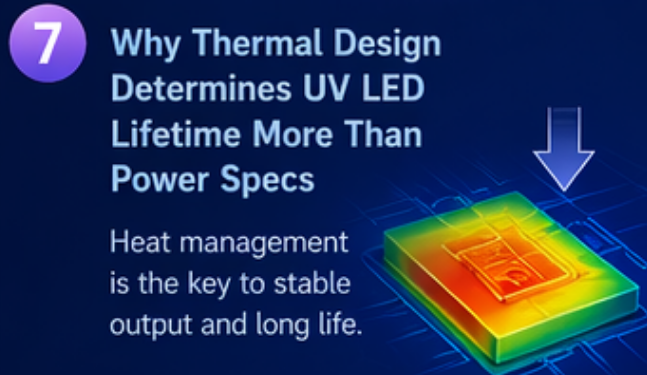
Many buyers compare UV LED modules by wattage alone. But experienced engineers know a different truth:
Thermal design often matters more than nameplate power.
A UV LED module may show excellent initial intensity, but without proper heat control, performance declines rapidly during real operation.
What Heat Causes
Poor thermal management can lead to:
- Lower radiant output
- Wavelength shift
- Faster lumen depreciation
- Driver stress
- Shorter lifetime
- Inconsistent curing or disinfection results
Why UV LEDs Are Sensitive
UV emitters typically convert a meaningful portion of electrical input into heat rather than usable UV radiation. That heat must move efficiently from junction to ambient.
Key Thermal Path Elements
Substrate Material
- Aluminum PCB
- Copper core board
- AlN ceramic
Mechanical Contact
Flat mounting surfaces, correct torque, thermal interface material quality.
Cooling Method
- Passive heatsink
- Forced air cooling
- Liquid cooling
Ambient Conditions
A module tested in open lab air behaves differently inside a sealed machine cabinet.
Example
A 395nm curing module may run well for 30 seconds on bench test. But in enclosed production equipment, junction temperature can rise sharply, reducing curing consistency over long shifts.
Smart Purchasing Decision
Instead of only asking:
“What is max power?”
Ask:
- What is output after 2 hours continuous run?
- What case temperature is assumed?
- Recommended heatsink size?
- Is thermal simulation available?
Peak numbers sell products. Stable numbers run factories.