
One of the most common questions in the UVC industry is whether a project should use 230nm, 265nm, 275nm, or 280nm LEDs. The answer depends less on trend and more on design intent. Each wavelength option sits inside the broader UVC band, but each may serve a different engineering purpose depending on the product architecture and end-use conditions.
For many commercial buyers, 265nm and 275nm are the most familiar. They are common reference points in germicidal design and are often requested in product development discussions. However, this does not mean they are always the best fit. A system built for compact integration, precise optical control, or a specialized treatment path may benefit from a different point inside the 230–280nm range.
A useful way to evaluate wavelength options is to focus on application logic. If the goal is a general-purpose germicidal design, standard wavelength options may simplify sourcing and validation. If the goal is a differentiated OEM solution, then a more tailored wavelength can become part of the product advantage. That is why customization matters: the best wavelength is the one that helps the whole system perform as intended.
The 230nm end of the range may attract interest in projects that require more specialized engineering or controlled irradiation behavior. It is less of a commodity choice and more of a design-led option. Meanwhile, 280nm may be suitable in cases where the system design, package, and optical path can take advantage of that spectral point. The point is not that one wavelength is universally better; the point is that each must be evaluated in context.
Another factor is component integration. A wavelength decision influences not just germicidal theory but also optics, materials, thermal design, and system layout. Engineers should ask how the selected wavelength behaves within the actual device rather than in isolation. The best lab number does not always create the best commercial product if the optical path, beam angle, or package design is mismatched.
Tolerance and repeatability are equally important. In scaled manufacturing, the value of a wavelength option is tied to how consistently it can be delivered. That is why experienced OEM buyers look beyond the nominal specification and consider supplier capability, grading, and customization flexibility.
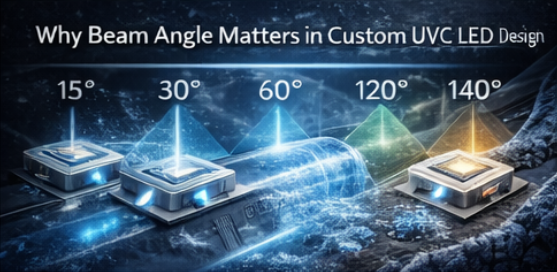
Beam angle should also be reviewed alongside wavelength. A narrow beam can concentrate UV energy in a local zone, which may help certain enclosed or directional applications. A wide beam can improve coverage for surfaces or broader exposure zones. When wavelength and beam angle are selected together, the design process becomes more efficient and the final system becomes easier to optimize.
For SEO content, this topic is highly valuable because it aligns with real search intent. Engineers often search comparison keywords before they search brand names. A strong comparison blog can attract upper-funnel technical traffic and then pass relevance and authority to the commercial product page. The most natural CTA is to guide readers toward your customizable germicidal LED page for project-based selection.
Ultimately, wavelength choice is not a popularity contest. It is a product decision. The right option depends on system goals, design constraints, and sourcing strategy. Brands that explain this clearly can attract more qualified traffic and generate stronger inquiries from buyers who already understand why customization matters.