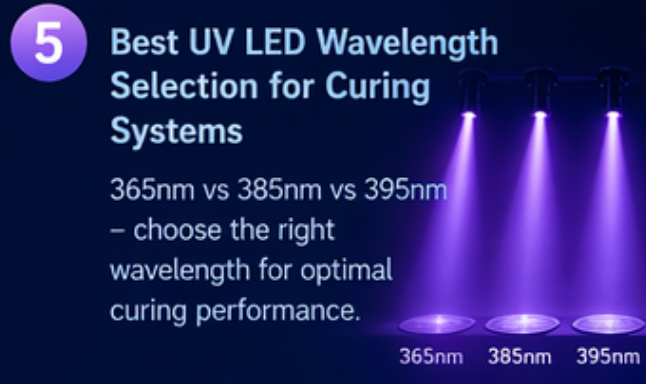
Selecting the correct UV LED wavelength is one of the most important decisions in curing system design. Many projects focus only on power output, but wavelength matching often determines whether a process performs efficiently or wastes energy.
The three most common curing wavelengths are 365nm, 385nm, and 395nm.
365nm UV LED
365nm is often used where deeper photoinitiator activation is required.
Common applications:
- High-performance adhesives
- Specialty coatings
- Electronics encapsulation
- Precision bonding
Advantages:
- Strong absorption for many photoinitiators
- Good through-cure capability
Considerations:
- Usually higher system cost than 395nm
- Thermal management still critical
385nm UV LED
385nm is widely considered the balanced industrial wavelength.
Applications:
- Printing inks
- Varnish curing
- Coatings
- General industrial adhesives
Advantages:
- Good curing speed
- Strong market compatibility
- Excellent balance of cost and performance
395nm UV LED
395nm is popular for economical high-power systems.
Applications:
- Large-area curing
- Conveyor curing
- Cost-sensitive industrial lines
Advantages:
- Lower cost
- High availability
- Strong output packages available
Considerations:
- Some materials may need reformulated chemistry
How Engineers Choose Correctly
Instead of asking “Which wavelength is strongest?”, ask:
- What photoinitiator is used?
- Required cure speed?
- Surface cure or deep cure?
- Heat sensitivity of substrate?
- Budget target?
Example
A wood coating line may run efficiently at 395nm.
A medical adhesive bonding process may need 365nm.
A printing press may choose 385nm as the best compromise.
Final Recommendation
Always validate wavelength with actual material testing, not theory alone. In many curing projects, the correct wavelength can outperform a higher wattage system at lower total power.