
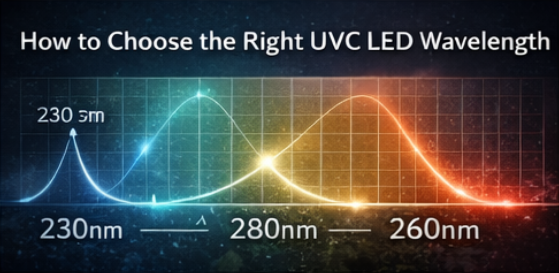
Choosing the right UVC LED wavelength is one of the most important steps in UV product design. Many buyers begin by asking for “a UVC LED,” but in practice, wavelength selection should follow the application. The 230–280nm range covers multiple design possibilities, and the right choice depends on your optical system, target environment, and performance goals.
The first point to understand is that wavelength is not just a number on a datasheet. It affects how UV energy interacts with microorganisms, surfaces, air paths, water channels, and surrounding materials. In product development, a better wavelength decision can improve optical efficiency, reduce unnecessary exposure, and simplify mechanical design.
For many germicidal projects, common target wavelengths include 265nm and 275nm. These values are frequently used because they align with mainstream germicidal design practice and are often easier to integrate into commercial UV systems. However, some projects need more specialized wavelength points within the 230–280nm range. That is especially true in compact instruments, experimental systems, or custom modules where beam path, sensitivity, or component compatibility are tightly controlled.
A practical way to choose wavelength is to start with the end-use environment. If you are designing a water disinfection component, consider flow rate, channel depth, available exposure time, and optical losses caused by materials or geometry. If you are working on an air-treatment device, think about residence time, duct layout, and whether the LED array will be used in a confined zone or a broader chamber. For surface treatment, beam angle and irradiation distance may be just as important as the wavelength itself. In healthcare or laboratory instruments, repeatability and specification accuracy often become top priorities.
Tolerance also matters. A nominal wavelength is useful, but engineering teams often need confidence in how tightly that value is controlled. A tighter wavelength tolerance can support product consistency across batches and improve predictability in applications where spectral performance matters. This is especially valuable in OEM projects that move from prototype to production and need fewer surprises during scale-up.
Another overlooked factor is how wavelength selection interacts with beam angle. A narrow beam may intensify exposure in a limited zone, while a wide beam may spread energy across a larger area. The ideal wavelength can only deliver its full value when the optical distribution supports the application. That is why experienced buyers evaluate wavelength and angle together, not separately.
Procurement teams should also consider future flexibility. If your current prototype uses one wavelength point but your commercial roadmap may include multiple SKUs, choosing a supplier with a broader customization range can reduce future sourcing friction. Instead of starting over when the product line expands, you can work within an established technical framework.
From an SEO and buyer-journey standpoint, your product page should be positioned as the destination for businesses that do not want to be limited to a single stock specification. In content, the best approach is to educate readers on how wavelength choice affects performance and then guide them naturally toward your 230–280nm UVC LED customization page for tailored options.
The main takeaway is simple: the right wavelength is the one that fits the actual use case, not the one that appears most often in generic product lists. By linking wavelength choice to optical design, tolerance, and application environment, brands can build stronger products and reduce engineering compromise from the start.