
When hardware engineers integrate deep UV technology into industrial air purification solutions, they quickly encounter the strict laws of thermodynamics. While UVC LEDs are vastly superior to traditional mercury lamps in size and flexibility, they convert only a small percentage of their electrical input into optical UV power; the remaining energy is converted into heat.
Because LED components are highly sensitive to temperature, effective thermal management is the deciding factor between a module that fails in 500 hours and one that runs smoothly for 30,000 hours.
The Impact of Junction Temperature (T_j)
The internal core of a UVC LED chip is called the junction. If the heat generated at this junction is not quickly drawn away, the internal temperature will spike. A high junction temperature causes two major problems:
-
Immediate Drop in Radiant Flux: The optical output power decreases significantly as the chip overheats.
-
Accelerated Aging: Prolonged exposure to high heat degrades the semiconductor lattice, permanently shortening the operating life of the chip.
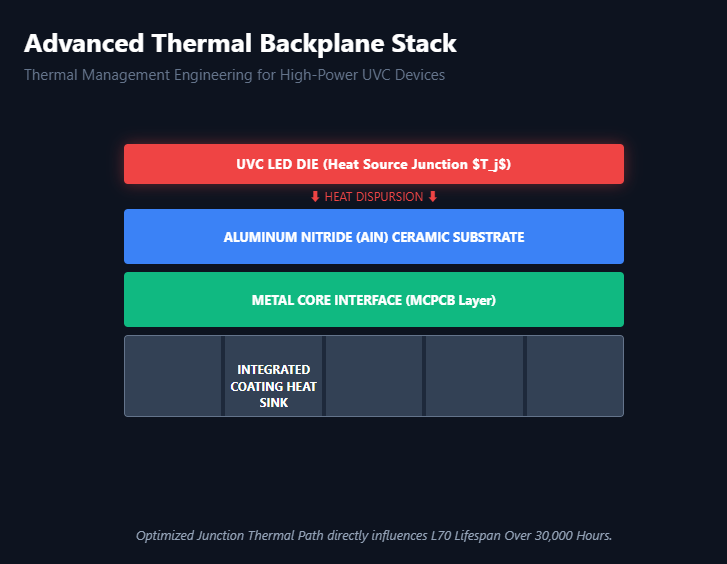
  [ UVC Die / Heat Source ]
            ↓
  [ High Thermal Conductivity Ceramic Substrate ]
            ↓
  [ Metal Core PCB / Thermally Conductive Paste ]
            ↓
  [ Aluminum Heatsink + Forced Air Integration ]
Advanced Thermal Engineering Strategies
To maintain peak disinfection performance, industrial designs must optimize the entire thermal path:
-
Aluminum Nitride (AlN) Substrates: Modern high-power UVC modules use ceramic substrates with high thermal conductivity to quickly pull heat away from the tiny chip die.
-
Metal Core PCBs (MCPCBs): Replacing standard FR4 circuit boards with metal-core alternatives ensures uniform heat distribution across the module base.
-
Fluid-Dynamic Heat Sinks: In air purification units, engineers can position aluminum fins directly inside the airflow path, turning the moving air into a built-in cooling mechanism.
Developing these advanced thermal layers requires deep cooperation between optical engineers and packaging material scientists. Manufacturers shouldn't have to tackle these complex cooling issues alone. Choosing a manufacturing partner that specializes in high-power UVC LED 230-280nm customization ensures that every custom module is pre-engineered with professional thermal backplanes, optimized drive currents, and robust materials, allowing your team to focus strictly on system-level product integration.