
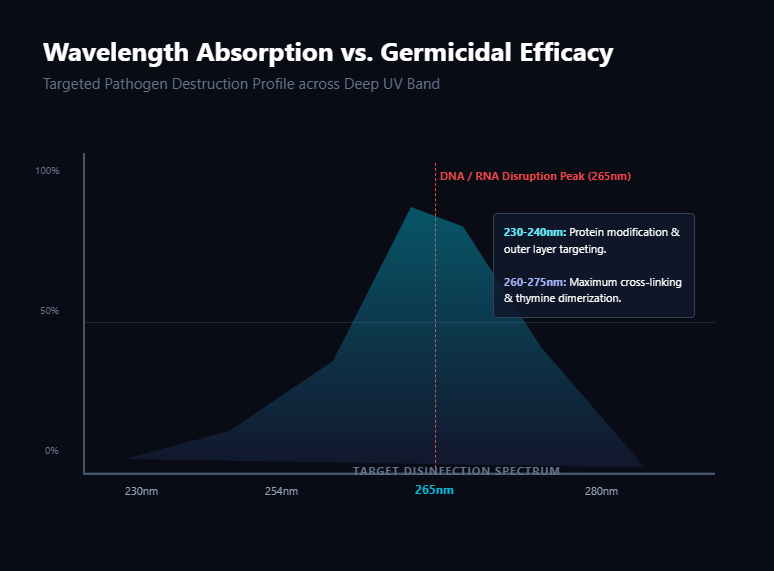
The core mechanism of uv led disinfection relies on light matching the absorption spectrum of microbial cellular matter. However, many developers mistakenly treat the deep ultraviolet spectrum as a uniform zone of efficacy. In reality, shifting your wavelength output by just 5 nanometers can alter your system’s germicidal log reduction performance by up to 30%.
   Wavelength (nm)     Target Cellular Target        Primary Efficacy
   ------------------------------------------------------------------
   230nm - 240nm       Microbial Peptide Bonds       Protein Denaturation
   260nm - 268nm       Deoxyribonucleic Acid         Peak DNA/RNA Destruction
   270nm - 280nm       Enzymatic Proteins            Cell Wall Rupturing
The Molecular Destruction Mechanism
When a cell is hit by deep UV photons, the energy targets the bonds linking nucleic acids together.
-
At 265nm: The cross-section of DNA and RNA absorption reaches its maximum. Photons induce adjacent thymine bases to fuse into pyrimidine dimers, permanently breaking the genetic replication code. The pathogen can no longer infect hosts or replicate.
-
At 230nm (Far-UVC): The mechanism shifts slightly toward protein destruction. This shorter wavelength has a high absorption rate in organic tissues, making it unable to penetrate the outer cornea or stratum corneum of human eyes and skin, providing an excellent safety profile for occupied spaces.
The Necessity of Tailored Spectrums
Different target pathogens display varying sensitivity profiles. For instance, eliminating Cryptosporidium or Giardia in water systems requires a slightly shifted energy peak compared to sanitizing airborne Influenza. A fixed, single-wavelength light source forces engineers to increase total power output to compensate for poor absorption.
The solution lies in multi-wavelength array tuning. Utilizing a platform equipped for precision UVC LED 230-280nm full-band customization empowers hardware developers to mix and match discrete wavelength chip dies on a single substrate. This maximizes absorption efficiency, minimizes power draw, and achieves the highest possible log reduction scores per watt.