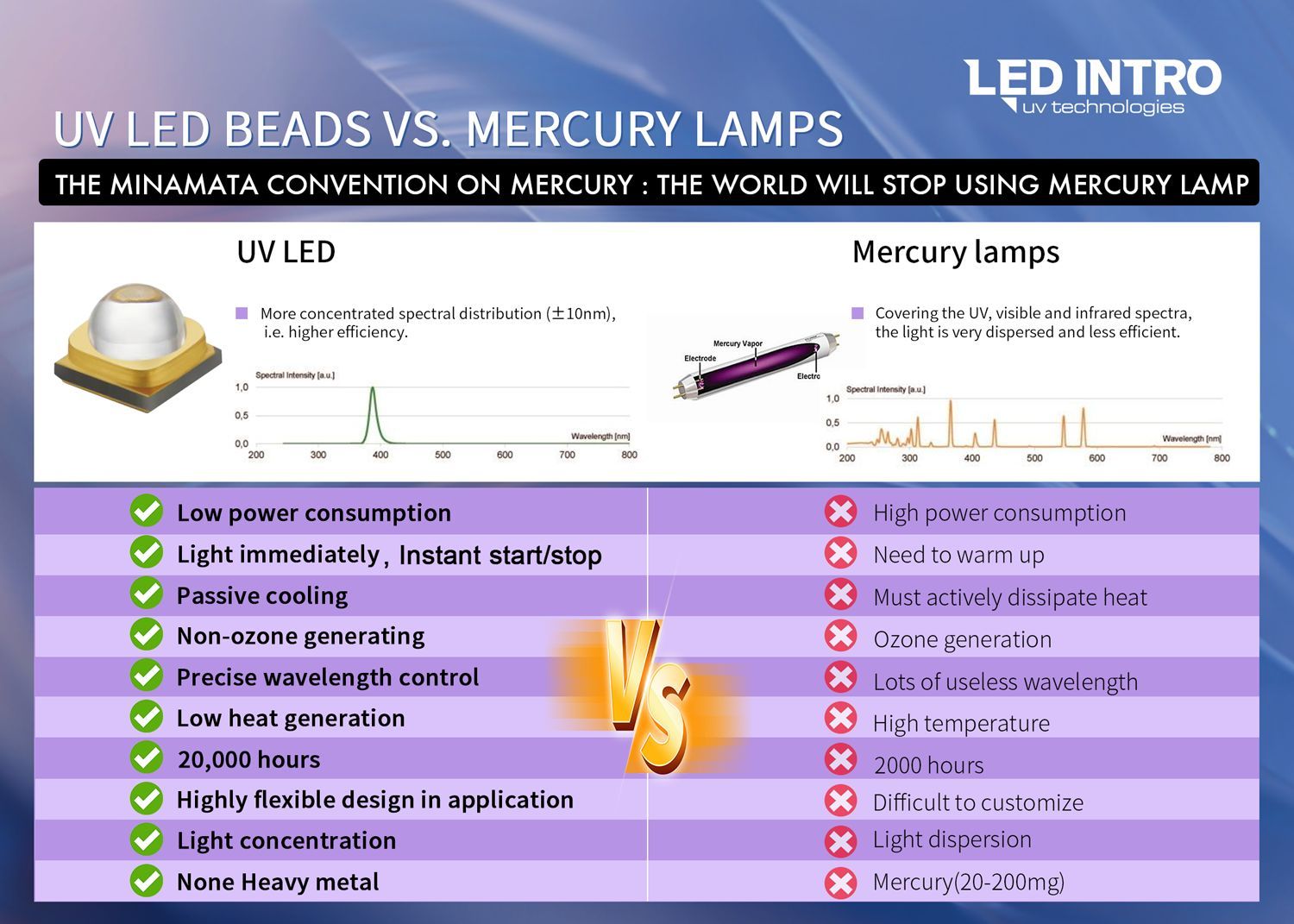
📣Focusing on the differences between the development of UVLED and traditional mercury lamps, we are constantly making progress.
Mercury lamps: Severe energy waste – Only approximately 20%-30% of the input electrical energy is converted into useful UV light, while the remaining 60%-70% is converted into infrared heat (lamp surface temperatures can reach 300-500°C). This requires additional high-power cooling systems (such as industrial fans and water chillers), resulting in total energy consumption 3-5 times that of UVLEDs.
📈Impact: High temperatures can cause deformation of substrates (such as plastics and films), requiring additional cooling stations and slowing production.
----------------------------------
UVLEDs: Low energy consumption + precise heat dissipation – Over 90% of the input electrical energy is converted into UV light, with heat concentrated on the chip (surface temperature 60-80°C). Only minimal air cooling or natural heat dissipation is required (some low-power models do not require additional heat dissipation), resulting in total energy consumption of only 1/3-1/5 that of mercury lamps.
📉Advantages: No risk of high-temperature damage, suitable for heat-sensitive substrates (such as PCBs and food packaging), while also reducing the load on workshop air conditioning.
UVLED MERCURYLAMPS EnergyConsumption Sterilization UVA UVB UVC ChemicalCatalysis
UV and Mercury lamps
29 set 2025 u-vcare