
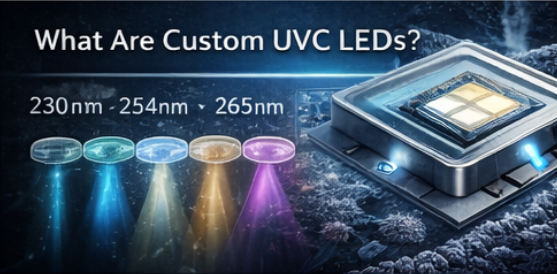
Custom UVC LEDs are semiconductor light sources engineered to emit ultraviolet radiation in the germicidal UVC range, usually for a specific application requirement rather than as a one-size-fits-all component. In real projects, the term “custom” may refer to wavelength selection, beam angle, chip count, irradiance target, package style, or system integration requirements. For OEMs and product engineers, customization matters because sterilization performance is never determined by one variable alone. It depends on optical design, exposure time, target microorganism, installation geometry, thermal conditions, and the intended end-use environment.
In many industries, standard UV components are good for evaluation, but not always ideal for final products. A water treatment device may need a narrow beam and stable output. A surface disinfection module may require a wider beam for better coverage. An air-treatment assembly may require multiple chips, controlled thermal design, and a wavelength choice that matches the design brief. That is why the custom UVC LED market continues to grow: integrators need better fit, not just higher power.
The 230–280nm range is especially important because it covers the core UVC band used in germicidal applications. Within that range, different wavelength points can serve different design priorities. Some buyers prefer commonly specified wavelengths such as 265nm or 275nm because they are widely used in germicidal product design. Others need a more specific wavelength window to fit a proprietary optical path, laboratory instrument, or compact sterilization chamber. A supplier that can support wavelength selection rather than only stock inventory gives product teams much more freedom.
Another reason customization matters is beam control. In UV systems, the same optical power can perform very differently depending on angle and placement. A 15° or 30° beam may be more suitable for concentrated irradiation, while 120° or 140° may work better for broader surface coverage. If your device is space-constrained, the beam angle becomes even more critical. Engineers often discover that layout and beam shape matter just as much as nominal output.
Chip count is another major factor. One chip may be enough for a compact point-of-use concept, but larger modules may require multiple chips to reach the desired irradiance level. The number of chips influences not only output but also heat management, board space, power design, and long-term stability. This is why smart sourcing starts with use case definition rather than price alone.
When evaluating a UVC LED supplier, engineers should ask several questions early. Can the supplier offer wavelength options within the target range? What tolerance can they hold? Are beam angles configurable? Can irradiance be tailored to the application? Is there support for OEM or integration projects? Can the vendor discuss how the component fits water, air, surface, or medical/lab use cases? These questions matter because component selection affects the performance envelope of the final product.
Customization also supports better product differentiation. In competitive markets, many devices look similar on the outside, but performance often depends on what is inside. A more precise wavelength, a more suitable beam angle, or a better chip configuration can help a brand build a more reliable sterilization module, water unit, or UV subsystem. That difference may not always be visible in a catalog photo, but it can shape engineering outcomes, product lifespan, and customer satisfaction.
For companies building UV-enabled products, a targeted sourcing strategy is often more effective than buying a generic part and forcing the system around it. If your project needs a configurable option across wavelength, optical angle, chip quantity, and irradiance, it makes sense to point readers toward your custom UVC LED solutions page as the core commercial destination.
In short, custom UVC LEDs are not just parts; they are application-specific building blocks. The more closely the LED specification matches the intended design environment, the easier it becomes to improve integration efficiency, reduce redesign cycles, and create a product with clearer technical value.