
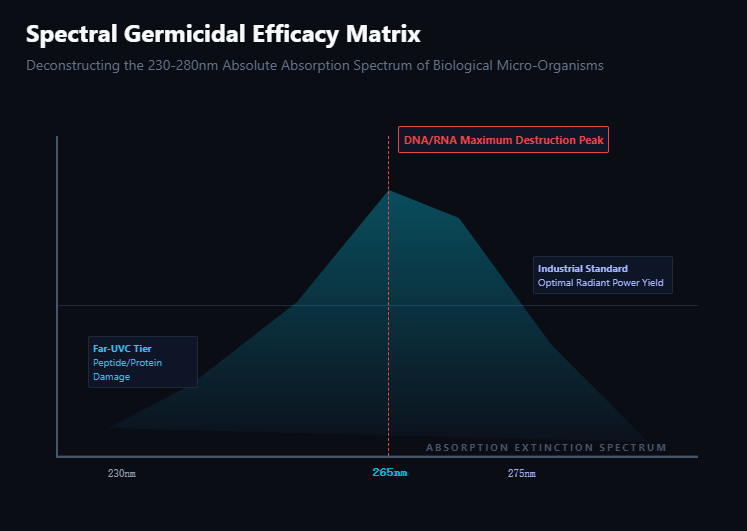
The deep ultraviolet spectrum is often treated as a single, uniform category on component datasheets. In reality, the 230nm to 280nm band contains unique sub-wavelength interactions that dictate germicidal performance. For R&D directors planning new product lines, selecting the ideal nanometer output requires a clear understanding of molecular biophysics.
  230nm ───► Peptide Bond Absorption ───► Protein Denaturation
  265nm ───► Purine/Pyrimidine Peak   ───► DNA/RNA Code Shattering
  275nm ───► High Flux Reliability     ───► Optimal Cost-per-Watt Balance
Breakdown of the Germicidal Sub-Wavelengths
-
260nm to 268nm (The Genomic Disruptor): This range matches the absolute peak absorption wavelength of microbial nucleic acids. Photons within this band are absorbed by purine and pyrimidine bases, creating pyrimidine dimers that permanently damage the pathogen's genetic material.
-
270nm to 280nm (The Industrial Balance Point): While slightly removed from the absolute DNA absorption peak, semiconductors emit significantly higher radiant flux at 275nm compared to shorter wavelengths. This makes it an exceptionally cost-effective option for large-scale water treatment loops and surface decontamination systems.
-
230nm to 240nm (The Far-UVC Safety Frontier): This shorter wavelength offers a distinct operational safety profile. Photons at 230nm are strongly absorbed by peptide bonds in proteins, allowing them to rapidly destroy surface bacteria while being unable to penetrate the protective outer dead skin layer or tear layer of human eyes.
Every disinfection application requires a specific spectral balance to maximize efficiency. Partnering with a manufacturer that offers comprehensive deep uv-c led 230-280nm full-band customization allows you to select single, targeted wavelengths or combine multiple bands on a single substrate, ensuring your system delivers the exact photon energy required for your specific application.