
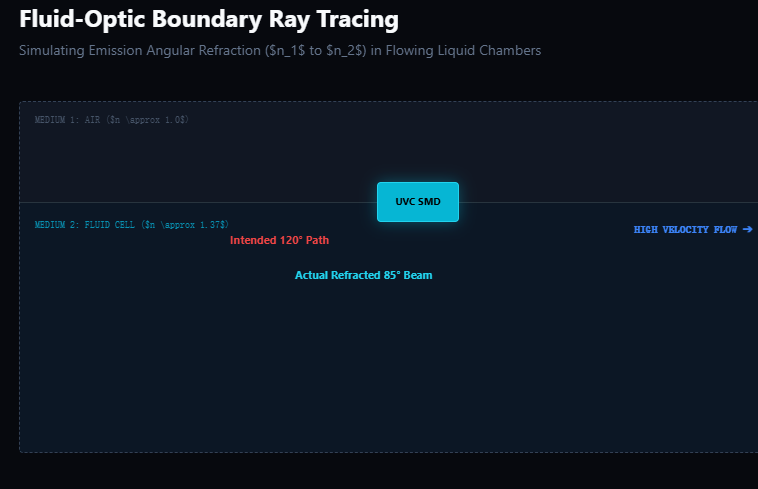
Integrating solid-state ultraviolet light sources into water purification loops or medical liquid chambers requires precise fluid-optic co-design. Unlike air, fluids introduce complex refraction indexes, organic absorption coefficients, and volatile velocity profiles. To ensure uniform sterilization, design engineers must utilize Computational Fluid Dynamics (CFD) paired with optical ray tracing to simulate how light from a deep uv-c led array interacts with a moving fluid stream.
The Optical Refraction Challenge in Fluids
When deep UV light passes from an LED lens into water, the change in the refractive index alters the emission beam angle. A chip designed to output a wide 120-degree angle in open air will narrow significantly when submerged or directed through a quartz sleeve into a liquid medium.
  In Open Air:   [ LED Chip ] ➔ 120° Wide Diffusion Angle
  In Fluid Cell: [ LED Chip ] ➔ [ Quartz Sleeve ] ➔ 85° Narrowed Beam (Refraction)
This beam narrowing can create unexposed areas near the outer chamber walls, allowing fast-moving microorganisms to slip through without receiving a lethal germicidal dose.
Selecting Lens Geometries for Specific Flow Profiles
-
30-Degree Narrow Lenses: Best suited for high-flow, localized reactor tubes. The focused beam cuts through low-transmittance liquids, delivering concentrated energy directly into the fastest-moving fluid zones.
-
120-Degree Flat Window Modules: Ideal for static storage tanks or shallow surface disinfection channels. This layout maximizes spatial coverage to eliminate stagnant bacterial growth along container walls.
To achieve complete microbiological safety, relying on standard light bars often leaves critical performance gaps. Working with a vendor that provides specialized deep uv-c led 230-280nm custom module design allows your team to specify custom lens distributions, matching the optical footprint exactly to your system's fluid dynamics to eliminate bypass zones.