
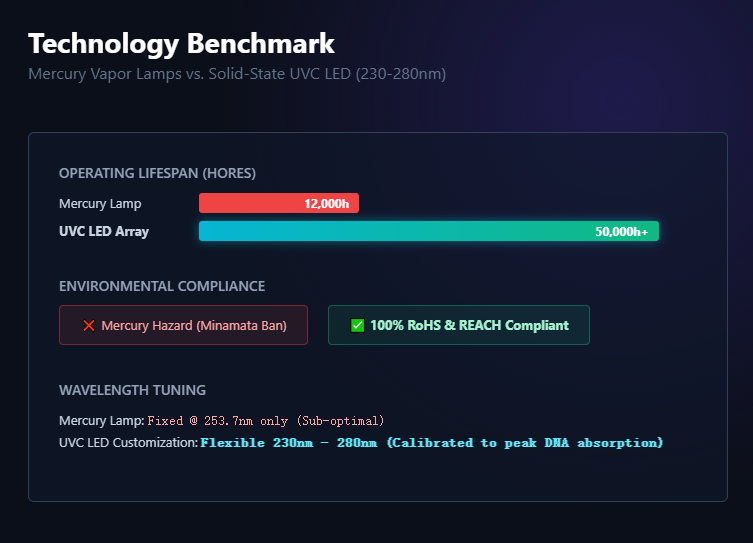
Engineers tasked with developing industrial or commercial air purification solutions face a critical architectural decision: Should the system utilize traditional low-pressure mercury lamps, or is it time to design around Solid-State UVC LED technology?
While mercury lamps have been the historical standard for ultraviolet germicidal irradiation (UVGI), advanced Solid-State Lighting (SSL) has reached a tipping point in radiant flux and cost-efficiency, making it the superior choice for modern B2B product development.
Direct Comparison: Mercury Lamps vs. UVC LEDs
| Feature | Low-Pressure Mercury Lamps | Solid-State UVC LEDs (230-280nm) |
| Form Factor | Bulky, fragile glass tubes (30cm - 1m+) | Ultra-compact surface-mount devices (SMDs) |
| Environmental Compliance | Contains toxic mercury (Restricted by Minamata Convention) | 100% Mercury-free, RoHS and REACH compliant |
| Warm-Up Time | Requires 1–5 minutes to reach full UV output | Instantaneous ON/OFF (0.1 microseconds) |
| Operating Lifespan | 8,000 – 12,000 hours (Greatly reduced by cycling) | 20,000 – 50,000+ hours (Independent of ON/OFF cycles) |
| Wavelength Tuning | Fixed strictly at 253.7nm | Customizable spectrum across the entire 230-280nm band |
Why Wavelength Customization Changes the Game
Mercury lamps emit a fixed wavelength of 253.7nm. While effective, it is not the absolute peak of microbial DNA absorption, which typically occurs closer to 265nm.
Moreover, traditional lamps cannot adjust to target specific threats or comply with specialized space restrictions. UVC LEDs remove these engineering bottlenecks.
Engineering Insight: By utilizing a scalable substrate, developers can arrange custom array geometries that match the specific fluid dynamics of their air ducts.
For manufacturers looking to future-proof their product lines against upcoming global mercury bans, partnering with an optical component expert is essential. Utilizing a flexible, high-power UVC LED 230-280nm full-band customization platform allows engineering teams to precisely match the peak germicidal wavelength to their specific optical chamber design, maximizing log reduction scores while minimizing energy draw.