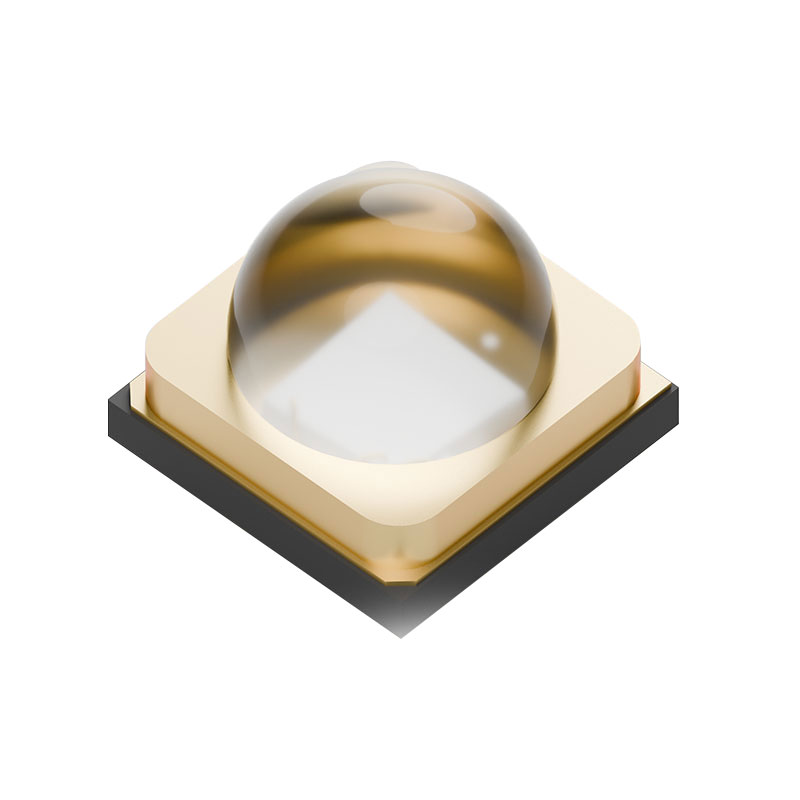
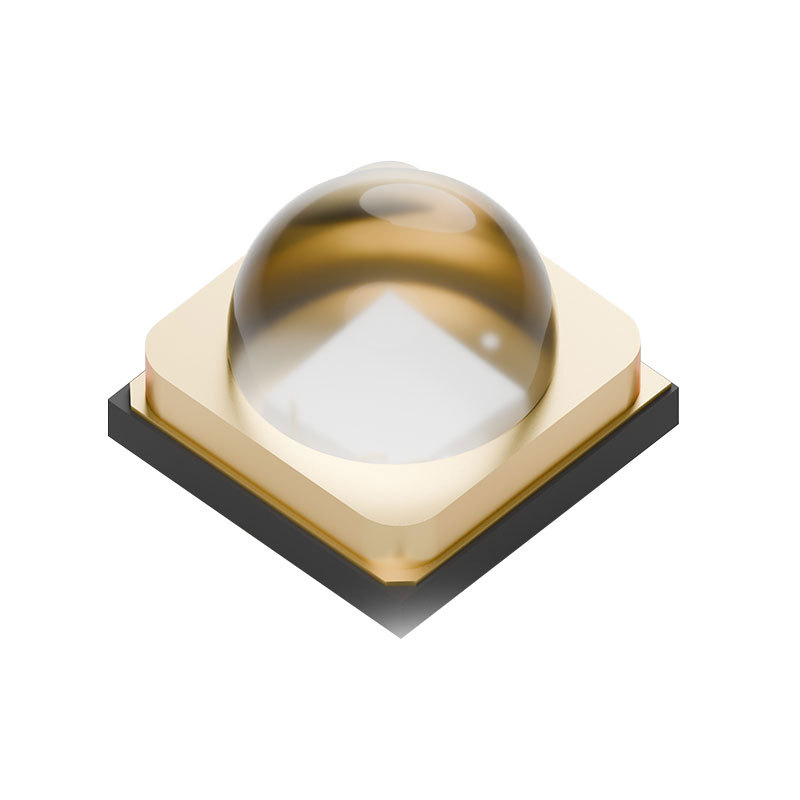
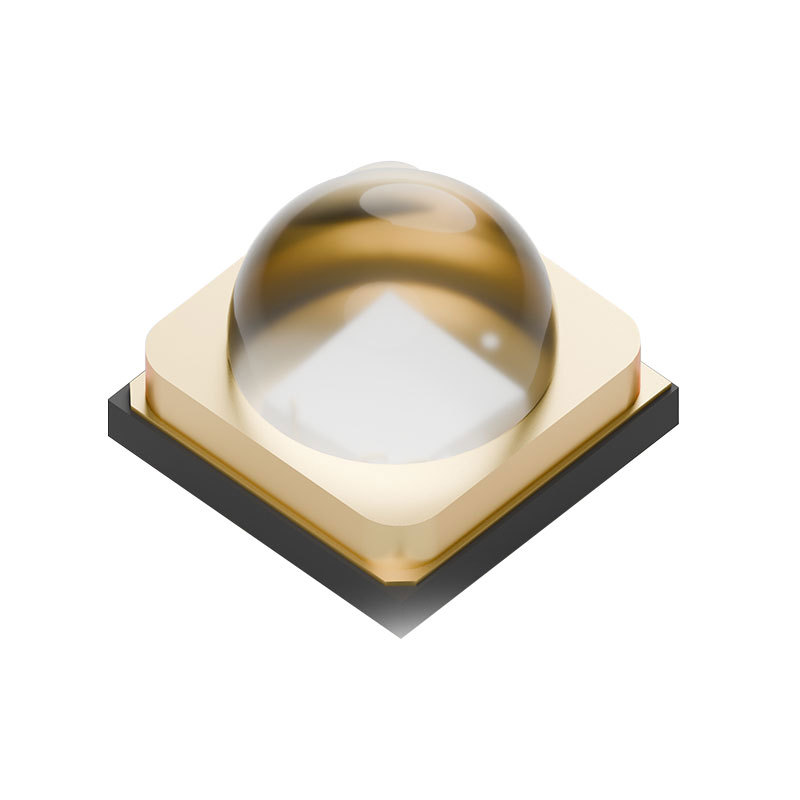
- Light Source for Sterilization and Medical Application
- Lighting Color(Peak Wavelength): 230 nm
- Surface Mount Type LED: 3.6 x 3.6 x 1.5 (L x W x H) [Unit: mm]
- Soldering Methods: Reflow Soldering
Notes: All dimensions are in millimeter and tolerance is ± 0.2mm unless otherwise noted
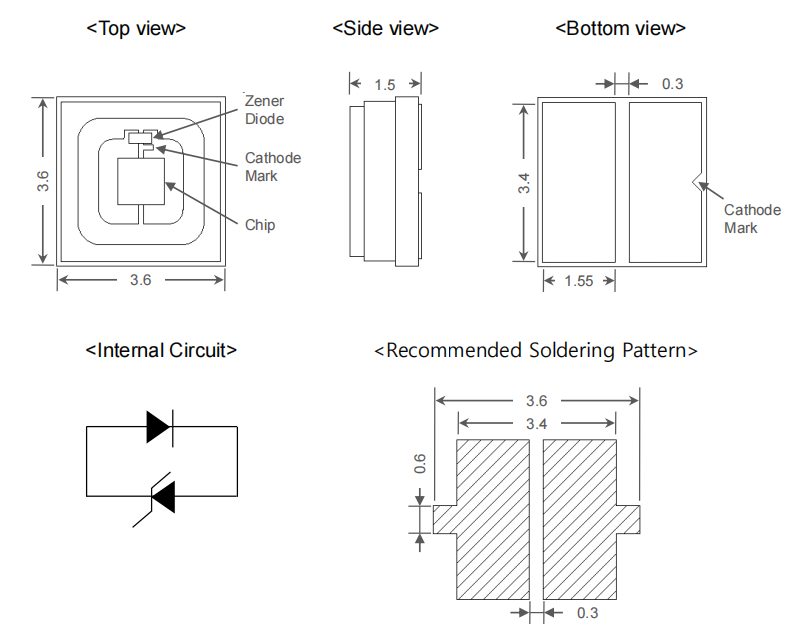
- Disinfection, Phototherapy, Fluorescent Spectroscopy, Sensor Light, Bio-Analysis / Direction, Counterfeit Detector etc.
- Operating the LED beyond the listed maximum ratings may affect device reliability and cause permanent damage. These or any other conditions beyond those indicated under recommended operating conditions are not implied. The exposure to the absolute maximum rated conditions may affect device reliability.
- The LEDs are not designed to be driven in reverse bias.
| Parameters |
Symbol |
Spec |
Unit |
| Min |
Typ |
Max |
| Forward Voltage |
V<sub>f</sub> |
6.0 |
7.0 |
8.0 |
V |
| Radiant Flux |
P<sub>o</sub> |
- |
3.0 |
- |
mW |
| Peak Wavelength |
λ<sub>p</sub> |
225 |
230 |
235 |
nm |
| Spectrum Half Width |
Δλ |
- |
11 |
- |
nm |
| Viewing Angle |
2Θ<sub>½</sub> |
- |
TBD |
- |
deg |
| Thermal Resistance(Junction to Solder point)Note 2 |
Rth<sub>J-S</sub> |
- |
TBD |
- |
°C/W |
- Measured by optical spectrum analyzer, some values may vary depending on the conditions of the test equipment.
- Forward Voltage (Vf):±0.1V
- Peak Wavelength (λₚ):±3nm
- Radiant Flux (Pₒ):±10%
- Thermal resistance can be increased substantially depending on the heat sink design/operating condition, and the maximum possible driving current will decrease accordingly.
6. Characteristic Curves (Ta = 25 ℃)
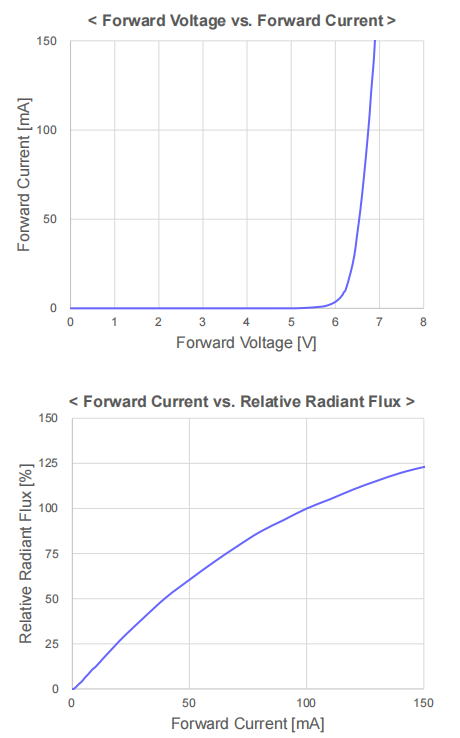
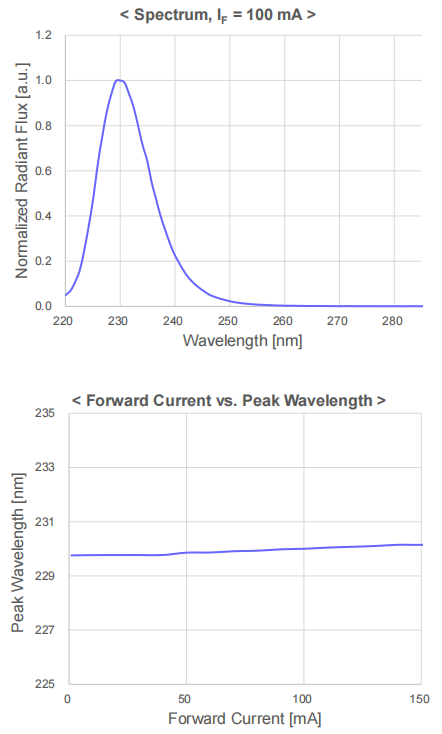
7. Packing and Labelling of Product
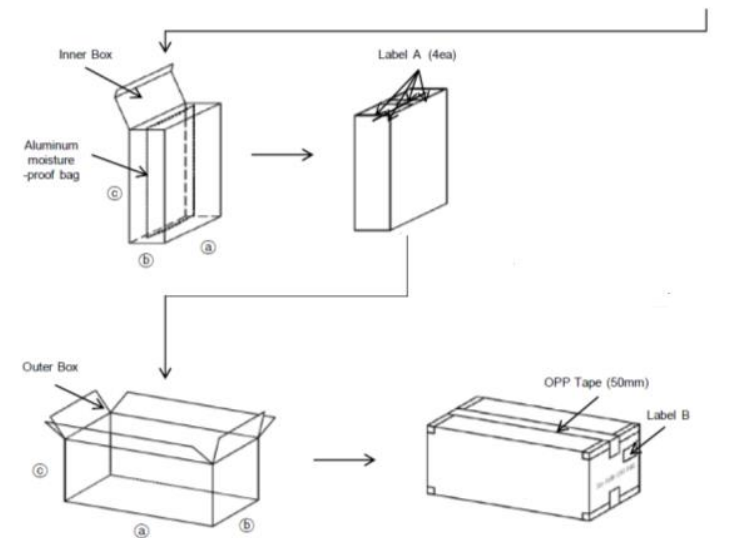
7-1. Package and Label Structure
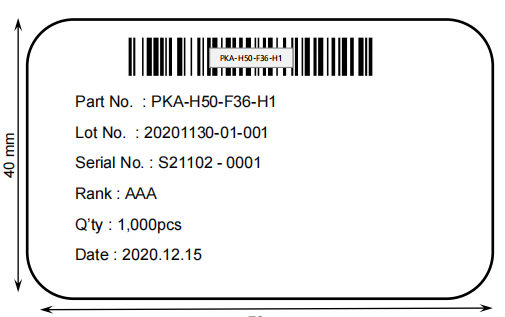
* Label A
Specifying Model Name, Rank, Rack, Quantity and Run number
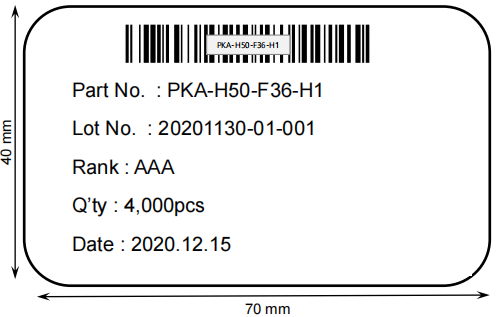
* Label B
Specifying Customer, Date, Model Name, Quantity, Customer Part Number, Outbox ID,
Rank/Rank Quantity
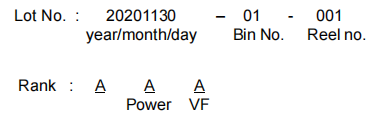
* Lot No. Indication
7-2. Packing Specifications
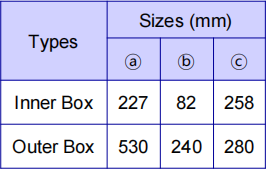
Reeled products(Numbers of products are Max.1,000pcs) packed in a sealed-off and moisture-proof aluminum bag with desiccants(Silica Gel). A Maximum four aluminum bags are packed in an inner box and six inner boxes are packed in an outer box. (Total Max. number of products are 24,000pcs)
Notes:
- Reeled products (number of products is max 1,000pcs)packed in a sealed aluminum bag.
- A maximum 4 bags are packed in an inner box.(Total max number of products is 4,000pcs)
- A maximum 6 inner boxes are packed in an outer box.(Total max number of products is 24,000pcs)
8. Guide for User
8-1. Soldering Condition
- Reflow Soldering is the recommended method for assembling LEDs on a circuit board.
- Photon Wave does not guarantee the performance of the LEDs assembled by the dip soldering method.
- Recommended Soldering Profile(According to JEDEC J-STD-020D)
- Reflow or hand soldering at the lowest possible temperature is desirable for the LEDs although the recommended soldering conditions are specified in the below diagrams.
- A rapid-rate process is not recommended for cooling the LEDs down from the peak temperature.
- Occasionally there is a brightness decrease caused by the influence of heat of ambient atmosphere during air reflow. It is recommended that the customer use the nitrogen reflow method.
- Glass plate is hermetic sealed on the LEDs. Therefore, the LEDs have a soft and very fragile surface on the top of the package.
- The pressure to the surface will be influence to the reliability of the LEDs. Precautions should be taken to avoid strong pressure on the silicone resin when leveraging the pick and place machines.
- Reflow soldering should not be done more than two times.
- Soldering Iron
- The recommended condition is less than 5 sec at 260 ℃.
- The time must be shorter for higher temperatures(+10 ℃ → -1 sec).
- The power dissipation of the soldering iron should be lower than 15 W and the surface temperature of the device should be controlled at or under 230 ℃.
8. Guide for User
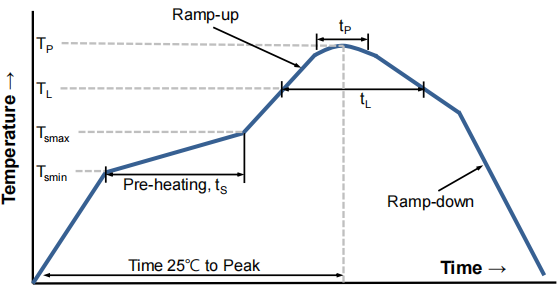
| Profile Feature(曲线特征) |
Lead Free Assembly |
| Average Ramp-up Rate (T<sub>smax</sub> to T<sub>p</sub>) |
3°C / sec Max |
| Preheating Temperature Min (T<sub>smin</sub>) |
150°C |
| Preheating Temperature Max (T<sub>smax</sub>) |
200°C |
| Preheating Time (T<sub>s</sub>, T<sub>smin</sub> to T<sub>smax</sub>) |
60 ~ 150 sec |
| Time Maintained Above Temperature (T<sub>l</sub>) |
60 ~ 150 sec |
| Time Maintained Above Time (t<sub>l</sub>) |
60 ~ 150 sec |
| Peak / Classification Temperature (T<sub>p</sub>) |
260°C |
| Time Within 5°C of Actual Peak Temperature (t<sub>p</sub>) |
5 sec |
| Ramp-down Rate |
6°C / sec Max |
| Time 25°C to Peak Temperature |
8 min Max |
8-2. Recommended Solder Pattern
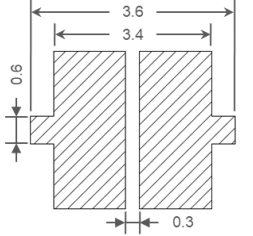
Notes:
- All dimensions are in millimeter and tolerance is ± 0.2mm unless otherwise noted
- Not guarantee the performance of the LEDs which have been already assembled using the dip soldering method.
- There is a radiant flux decrease caused by the influence of heat of ambient atmosphere under air reflow condition. We recommend to use the nitrogen reflow method.
- Reflow soldering should not be done more than two times.