
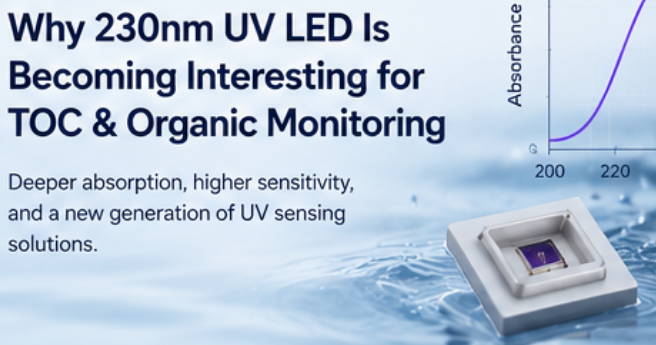
In deep-UV water analysis systems, wavelength selection directly determines sensing sensitivity.
And recently, one wavelength has been attracting increasing attention in advanced water-monitoring applications:
230nm.
Most discussions around UV LEDs still focus on sterilization wavelengths such as 265nm or 275nm.
But in semiconductor ultrapure water systems, laboratory analysis equipment, and TOC-related monitoring platforms, 230nm UV LED is becoming extremely interesting for a different reason.
Not because it is a better sterilization wavelength.
But because it offers strong sensitivity for organic absorbance detection.
Why 230nm Matters in Water Monitoring
Many organic compounds exhibit stronger UV absorption characteristics at shorter deep-UV wavelengths.
This means 230nm can provide enhanced sensitivity for detecting:
- dissolved organic compounds
- TOC-related absorbance trends
- contamination fluctuation
- organic residue buildup
- water-quality instability
In practical systems, this improves the ability to monitor subtle water-quality changes before they become larger process issues.
This is particularly important in:
- semiconductor UPW systems
- pharmaceutical water systems
- analytical laboratory equipment
- precision process-water monitoring
- scientific instrumentation
Why Conventional Light Sources Are Becoming Difficult
Traditionally, deep-UV sensing systems often relied on deuterium lamps.
However, these systems present several limitations:
- large physical size
- thermal instability
- slower response
- higher power consumption
- shorter operational life
- difficult compact integration
As analytical systems become smaller and more modular, these limitations become increasingly problematic.
Why 230nm UV LED Changes Sensor Design
Deep-UV LEDs allow much more compact optical architectures.
Compared with conventional lamps, 230nm UV LEDs enable:
Compact Integration
The light source can be embedded directly into:
- flow cells
- portable analyzers
- inline sensors
- compact monitoring modules
Fast Dynamic Operation
UV LEDs provide instant activation and dynamic modulation.
This supports:
- pulse-based sensing
- synchronized signal analysis
- lower standby energy consumption
Narrow Optical Control
Customized optical-angle design improves:
- detector coupling efficiency
- signal-to-noise ratio
- optical-path precision
- transmission stability
In many systems, beam angle becomes more important than absolute optical power.
Why Optical Architecture Matters
Deep-UV systems are highly sensitive to optical loss.
Even small amounts of scattering or divergence can significantly reduce signal quality.
For this reason, many 230nm projects require:
- narrow-angle optical design
- low-stray-light structure
- quartz optical paths
- specialized ceramic packaging
- precise detector alignment
The UV LED itself becomes part of the sensing architecture.
The Future of Deep UV Water Sensing
As semiconductor and pharmaceutical industries demand increasingly precise water analysis, deep-UV sensing systems will continue evolving.
And unlike conventional UV sterilization discussions, the value of 230nm lies more in:
- sensitivity
- precision
- optical control
- compact integration
- intelligent sensing capability
This is one reason why 230nm UV LED development is becoming strategically important in advanced water-system engineering.
For customized 230–280nm UV LED solutions used in deep UV sensing and ultrapure water monitoring, explore: https://www.u-vcare.com/products/uvc-leds-230-280nm-full-band-customization