
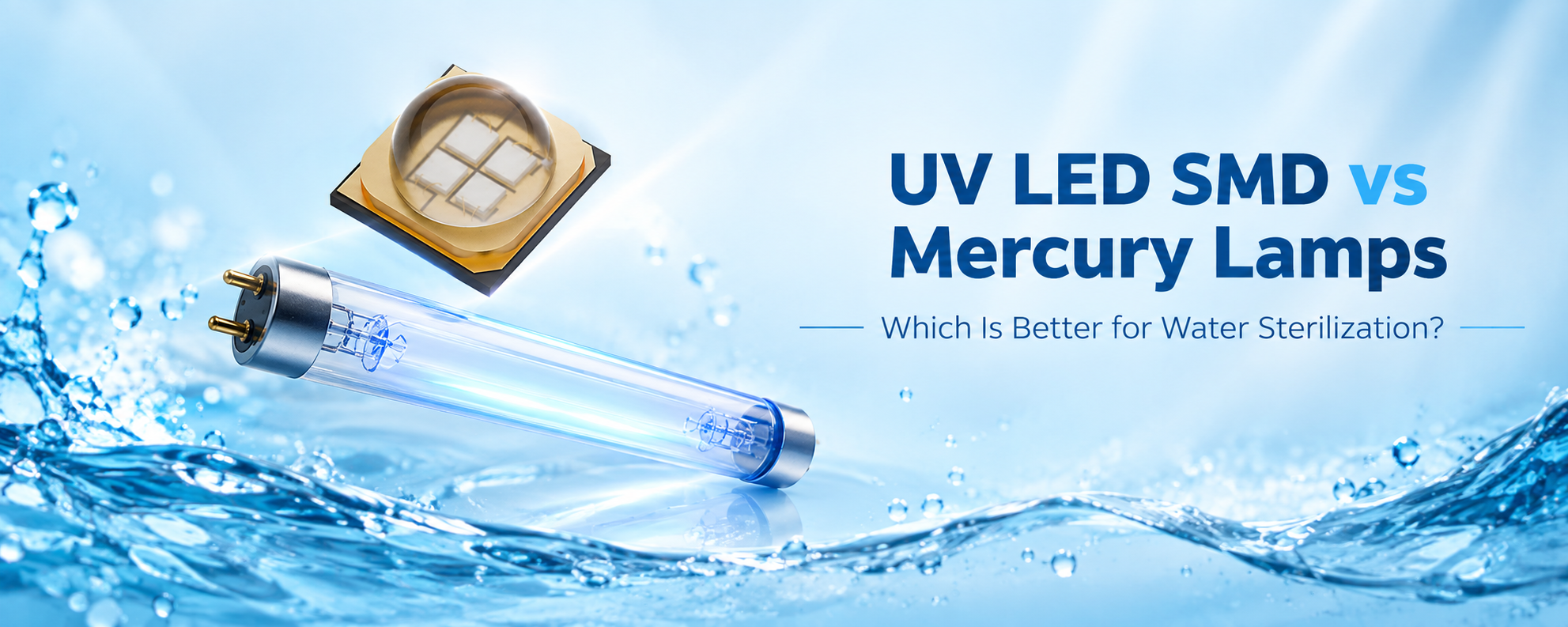
Ultraviolet (UV) disinfection has been used in water treatment for decades, with low-pressure mercury lamps remaining a familiar UV source in many systems. At the same time, UV LED technology has developed rapidly, making mercury-free UV sources increasingly practical for point-of-use, point-of-entry, industrial, and other water treatment applications.
The shift is not simply about replacing one light source with another. Mercury regulations, system size, operating conditions, maintenance requirements, wavelength selection, and total system cost all need to be considered when choosing between conventional mercury lamps and UV LED SMD for water sterilization.
So, when comparing UV LED vs mercury lamp, which option is more suitable for a new water sterilization system?
The answer depends on the application. UV LED SMD technology offers several design and operating advantages, but mercury lamps can still be practical for some high-power systems.
How Each Technology Works
A conventional low-pressure mercury lamp produces UV radiation through an electrical discharge in mercury vapor. Low-pressure mercury lamps are widely associated with emission around 254 nm, which has long been used for UV disinfection.
A UV LED SMD uses a semiconductor chip to generate UV radiation. Instead of relying on mercury vapor and an electrical discharge, the LED converts electrical energy into UV light through electroluminescence.
One important difference is wavelength flexibility. Mercury lamps have a relatively fixed emission spectrum, while UV LEDs can be manufactured around different peak wavelengths. This gives system designers more flexibility when matching the UV source to the target microorganisms and reactor design. Research has identified wavelengths around 260–265 nm as particularly effective for many microbial inactivation applications, although the optimum choice depends on the target organism and system conditions.
The difference becomes even more important when the UV source is integrated into a compact flow-through water treatment module. In such systems, optical distribution, water flow, exposure time, and delivered UV dose all influence the final disinfection performance.
6 Key Comparison Factors
1. Wavelength Accuracy and Germicidal Efficiency
Wavelength is one of the first factors to consider when comparing UV LED and mercury lamp systems.
Low-pressure mercury lamps are commonly used at approximately 254 nm. UV LEDs, however, can be produced at different wavelengths, allowing designers to select a source based on the target application.
This does not mean that a UV LED automatically provides better disinfection simply because its wavelength is closer to a microbial absorption peak. The actual result depends on optical power, UV dose, exposure time, water quality, reactor geometry, and the sensitivity of the target microorganism.
Recent reviews have found that UV LEDs can achieve comparable microbial inactivation to conventional UV technologies when systems are properly designed and operated.
For this reason, it is more useful to compare delivered UV dose and reactor performance than to compare wavelength alone.
2. Lifespan
Lamp replacement is an important part of the operating cost of UV water treatment equipment.
Traditional mercury lamps have a limited operating life and their UV output decreases over time. UV LED devices can offer longer operating lifetimes, with many products specified in the range of 10,000–30,000 hours or more depending on the device and operating conditions.
However, the lifetime of a UV LED should not be treated as a fixed number.
UV LEDs generate heat, and their long-term performance is strongly affected by junction temperature, current, thermal design, and operating environment. The lifetime specified for an individual LED package may also differ from the practical lifetime of the LED inside a complete water sterilization module. The International Ultraviolet Association has specifically noted that lifetime values should be considered carefully because the thermal environment during actual system operation can differ from standardized device testing.
A fair comparison therefore requires looking at the expected UV output over the intended operating period, rather than simply comparing nominal hours.
3. Warm-Up Time and Instant On/Off
This is one of the clearest operational differences.
Mercury lamps generally require a start-up period before reaching stable operating conditions. For systems that operate continuously, this may not be a major issue. For systems that start and stop frequently, however, the warm-up process can become less convenient.
UV LEDs are solid-state devices and can operate immediately when driven. They can also be switched on and off rapidly without requiring the same warm-up process.
This makes UV LEDs particularly suitable for water systems that operate according to flow detection, sensors, timers, or intermittent demand. Research on UV LED water disinfection systems also identifies instant-on operation as an important advantage for intermittently operated systems.
For systems where fast response is important, consider [our UV LED SMD modules with instant start].
4. Size and Design Flexibility
The physical structure of the UV source can strongly influence the design of a water sterilization system.
Mercury lamps are generally tubular and require additional components such as lamp sleeves, holders, electrical connections, and space around the lamp. This can limit how small or customized the reactor can be.
UV LED SMD packages are much smaller and can be arranged in different patterns. Multiple LEDs can be positioned according to the geometry of the water channel rather than simply following the shape of a lamp.
This creates more options for compact reactors, narrow water channels, multi-LED arrays, and customized modules.
For example, instead of designing the water channel around a long UV lamp, engineers can arrange UV LED sources around the areas where greater UV intensity is required.
However, this flexibility also creates a design challenge: LEDs are point-like or relatively localized sources, so the light distribution may be less uniform if the optical layout is not properly designed. Recent research identifies light distribution, reactor geometry, hydrodynamics, and thermal management as key factors in UV LED water treatment.
5. Environmental Impact
One fundamental difference is that UV LEDs do not contain mercury.
Mercury is a toxic heavy metal, and international efforts under the Minamata Convention aim to reduce mercury pollution and phase out specified mercury-added products. The Convention does not mean that every mercury-containing UV water-treatment lamp is universally prohibited, so system designers should check the regulations applicable to their specific market and product.
Nevertheless, removing mercury from the UV source eliminates concerns associated with mercury-containing components at the end of their service life.
This can also simplify the environmental management story for manufacturers developing new water treatment equipment, especially where mercury-free product design is an important requirement.
6. Total Cost of Ownership
Initial purchase price is only one part of the cost comparison.
A mercury lamp system may have a lower source cost in some applications, but the complete cost can include lamp replacement, maintenance, cleaning of lamp sleeves, downtime, and disposal requirements.
A UV LED system may have a higher initial component cost, while offering advantages such as long operating life, instant operation, compact design, and reduced maintenance requirements.
Energy consumption should also be compared at the system level rather than by comparing the electrical wattage of individual light sources.
For example, two systems may use different optical powers, wavelengths, reactor geometries, and flow rates. A lower electrical input does not automatically mean that the system delivers the required UV dose.
The most useful comparison is therefore:
Total cost of ownership = initial system cost + energy cost + maintenance + replacement + downtime over the expected service period
For a new system, this calculation can be more meaningful than comparing the purchase price of a mercury lamp with the purchase price of a UV LED module.
When Mercury Lamps Still Make Sense
UV LED technology has developed significantly, but replacing mercury lamps is not always the right decision.
Mercury lamps can still be practical for applications that require relatively high UV output, established large-scale reactor designs, or well-understood operating procedures.
Recent research continues to identify low-pressure mercury lamps as a robust option for large-scale UV applications, while UV LEDs still face challenges related to wall-plug efficiency and system economics at higher power levels.
This is particularly relevant when evaluating a large flow rate where a substantial UV dose must be delivered continuously.
Therefore, the key consideration is which UV source can deliver the required dose, flow rate, lifetime, and operating cost within the available system volume.
For compact water sterilization equipment, intermittent operation, customized reactor geometry, or mercury-free product development, UV LED SMD can provide significant design advantages.
For very high-power continuous treatment, conventional mercury technology may still remain practical depending on the system requirements.
How to Upgrade from Mercury to UV LED SMD
Replacing a mercury lamp with a UV LED module is not simply a matter of installing an LED with the same electrical power.
A proper upgrade should normally include the following steps:
- Define the existing system requirements
Record the current flow rate, target microorganisms, required UV dose, water quality, operating time, and available installation space.
- Measure the existing UV performance
Determine the actual UV output and dose delivered to the water rather than using the lamp's rated electrical power as the main reference.
- Select the UV LED wavelength
Wavelength is therefore not simply a matter of choosing the shortest available UV wavelength. The appropriate UV LED should be selected according to the target microorganism, required UV dose, water quality, optical design, and the efficiency of the LED at the operating wavelength. For systems where wavelength selection is part of the design process, UVC LED solutions covering 230–280 nm can provide more flexibility for matching the light source to the application.
- Redesign the optical layout
Determine LED quantity, spacing, emission angle, lens configuration, and installation position to achieve suitable UV distribution throughout the water channel.
- Design thermal management
UV LED performance is strongly affected by temperature. The LED package, substrate, heat path, and module housing should therefore be considered together.
- Validate the complete reactor
The final system should be tested under representative flow and water conditions to confirm that the required UV dose and microbial reduction are achieved.
This last step is particularly important. UV LED systems should be evaluated as complete disinfection systems, not only as individual LED components. Current guidance for UV LED fluid disinfection emphasizes validation, UV monitoring, wavelength-specific considerations, water transmittance, and system geometry.
Choosing the Right UV Source for Your Water Treatment System
The transition from mercury lamps to UV LED SMD technology is not simply a change in light source. It is a change in how the entire water disinfection system can be designed.
Mercury lamps remain a practical option for some high-power applications, while UV LED SMD technology provides greater flexibility for compact, customized, intermittent, and mercury-free water sterilization systems.
The most reliable approach is to start with the required UV dose, flow rate, wavelength, optical distribution, thermal conditions, and expected operating lifetime. Once these requirements are clear, the appropriate UV source and module structure can be selected around the actual application.
Contact our technical team to discuss the UV LED source and module configuration for your project.