
Introduction
As the world moves toward continuous disinfection in occupied spaces, the safety of Ultraviolet germicidal irradiation (UVGI) is under intense scrutiny. Traditional 254nm mercury lamps and 275nm UVC LEDs are effective but pose risks to human skin and eyes. Enter 230nm Far-UVC LED technology—the breakthrough in "human-safe" sterilization.
The Biophysics of Safety
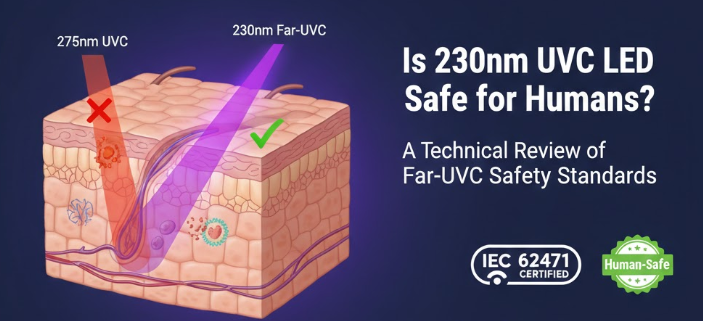
The safety of the 230nm wavelength lies in its limited penetration depth. Photons at $230nm$ are highly absorbed by proteins and organic molecules in the stratum corneum (the outer layer of dead skin cells) and the ocular tear layer. Unlike 275nm light, 230nm radiation cannot reach the living cells of the epidermis or the sensitive lens of the eye.
Compliance with ACGIH and IEC
For B2B buyers in the US and Germany, compliance is non-negotiable. The ACGIH (American Conference of Governmental Industrial Hygienists) has significantly increased the Threshold Limit Values (TLVs) for Far-UVC light. Our u-vcare 230nm LEDs are engineered with strict spectral control (225-235nm), ensuring that they operate within the "Safe Zone" while delivering sufficient radiant flux to deactivate pathogens like MRSA and SARS-CoV-2.
Conclusion
By integrating 230nm Far-UVC into your products, you offer a solution that protects people without the need for shielding or motion sensors.