
Sourcing optical components at a commercial scale requires strict verification protocols. In the deep UV market, raw component datasheets can sometimes be misleading or reflect unrepeatable ideal laboratory setups. For B2B procurement managers and quality assurance teams, the ability to analyze and verify an integrating sphere test report is critical to protecting your production line from low-performing components.
                  INTEGRATING SPHERE VERIFICATION MATRIX
  ┌───────────────────────┬──────────────────────────────────────────┐
  │ Key Metric            │ Sourcing Verification Requirement        │
  ├───────────────────────┼──────────────────────────────────────────┤
  │ Peak Wavelength ($nm$)│ Must fall within $\pm 3nm$ tolerance     │
  │ FWHM ($nm$)           │ Narrow spectral line width (<$12nm$)      │
  │ Radiant Flux ($mW$)   │ Recorded at steady-state thermal balance │
  └───────────────────────┴──────────────────────────────────────────┘
Essential Metrics on the Test Report
When auditing a vendor's radiometric test output, prioritize these three parameters:
-
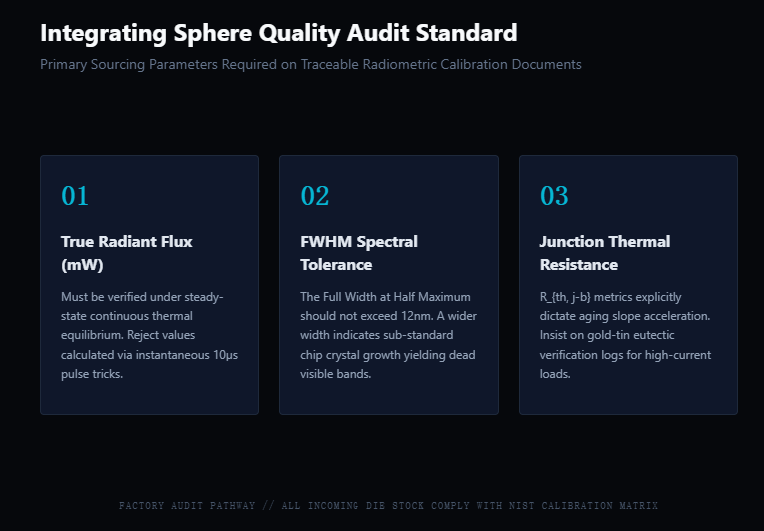
Radiant Flux (mW) vs. Forward Current (I_f): Verify that the optical output power was recorded at a realistic operating temperature, not during an instantaneous microsecond pulse test. Look for steady-state values where the chip has reached full thermal equilibrium.
-
Peak Wavelength and FWHM: Ensure the peak emission falls within your target germicidal range with a tight Full Width at Half Maximum (FWHM) of less than 12nm. This confirms the chip is emitting pure, effective deep UVC energy without wasting power on useless visible or infrared light.
-
Thermal Resistance (R_{th, j-b}): High-quality modules report a very low junction-to-board thermal resistance. A high R_th value indicates poor chip bonding, which will lead to accelerated optical output drop in production.
Sourcing sub-standard components introduces significant product liability risks. Working with an open, compliance-verified manufacturing partner ensures your supply chain remains stable. All of our validated deep uv-c led customized modules ship with traceable integrating sphere reports and comprehensive reliability dossiers, giving your quality control team full confidence before production begins.