
The global standard for Indoor Air Quality (IAQ) has fundamentally shifted. In modern commercial buildings, hospitals, and educational facilities, managing dust and pollen is no longer the primary challenge. The real threat lies in airborne pathogens—viruses, bacteria, and fungal spores—that circulate through centralized ventilation systems.
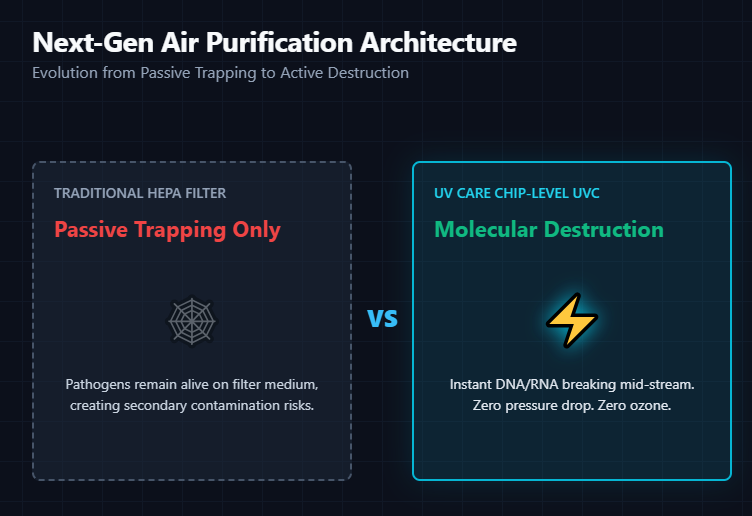
For decades, facility managers relied heavily on High-Efficiency Particulate Air (HEPA) filters as their primary air purification solutions. While HEPA filters are excellent at trapping physical particles, they have a critical, underlying limitation: they only capture, they do not kill.
The Hidden Risks of Passive Filtration
When a commercial HVAC system relies solely on passive filtration, microorganisms remain alive on the filter medium. Over time, factors like humidity can lead to mold growth and bio-accumulation. This creates a risk of secondary contamination during filter maintenance or in the event of a pressure drop. Furthermore, high-MERV or HEPA filters create significant airflow resistance (pressure drop), forcing ventilation systems to consume up to 30% more energy to maintain standard air exchange rates.
Shifting to Active Chip-Level Sterilization
To build truly resilient spaces, global equipment manufacturers (OEMs) are transitioning from passive filtration to active, molecular-level destruction. Instead of waiting for pathogens to be trapped, next-generation engineering integrates germicidal irradiation directly into the airflow path.
By destroying the microbial DNA and RNA mid-stream, systems can eliminate over 99.9% of viruses without restricting airflow. Achieving this requires moving away from bulky, old-school technology and adopting scalable optical engineering. Implementing a compact, high-efficiency customized 230-280nm UVC LED module allows engineers to destroy pathogens instantly without adding static pressure to the system, paving the way for the future of sustainable, high-volume clean air architecture.